
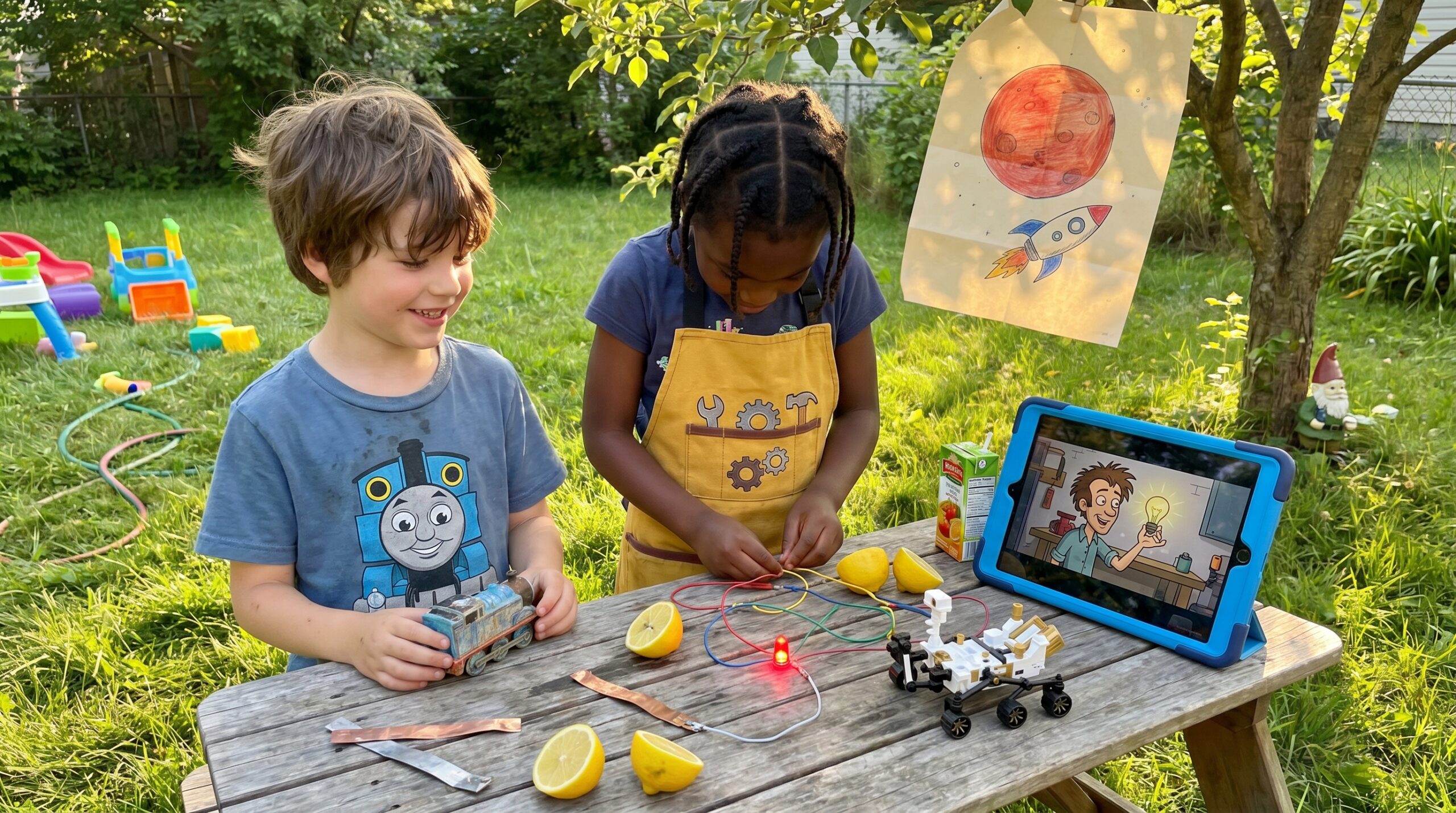
This Thomas Edison biography for kids tells a lively, clear story of a curious inventor. He loved tiny experiments and careful notes, and he changed everyday life.
Early life and the love of tinkering
Thomas Edison was born on February 11, 1847, in Milan, Ohio. He had little formal schooling and learned at home from his mother. As a teen he worked as a telegraph operator. That job pushed him toward sound and recording. He tested small changes, again and again, until something worked. Edison died on October 18, 1931, in West Orange, New Jersey, at the age of 84.
Key inventions and first successes
In 1877 Edison invented the phonograph, the first device to record and play back sound. Then, in the late 1870s and early 1880s, he improved filaments and vacuum techniques. As a result he created a practical incandescent lamp. He did not invent electric light from scratch. However, he made a durable, scalable lamp and helped build systems to power neighborhoods. Edison held a world-record 1,093 patents, with 389 of them specifically for electric light and power, showcasing his significant contributions to electrical technology.
Pearl Street and motion pictures
In 1882 his Pearl Street Station in Manhattan began commercial electric service. Next, his labs produced early motion picture devices with collaborators like W. K. L. Dickson. Edison kept meticulous notes. He ran daily trials and tried many small variations. This steady work led to more than 1,000 U.S. patents and several businesses to make inventions real. In fact, he executed his first U.S. patent application on October 13, 1868, which was issued as U.S. Patent No. 90,646 on June 1, 1869, marking a pivotal moment in his journey as an inventor.
Menlo Park, West Orange, and invention labs
Menlo Park and later West Orange were Edison’s invention factories. He organized teams of craftsmen and technicians. He built a routine of daily tests and careful record keeping. That routine helped turn ideas into real products. His famous line captures it: “Genius is one percent inspiration and ninety nine percent perspiration.” Notably, Edison’s Menlo Park laboratory, established in 1876, was the first industrial research laboratory, setting a precedent for modern R&D facilities.
Clearing up myths and context
Many myths follow famous inventors. For example, Edison often worked with assistants. He did not single handedly invent every device tied to his name. Also, the AC versus DC rivalry shows invention can sit inside business and politics. Still, his persistence and love of tinkering matter as a model.
Quick timeline
- 1847 born
- 1877 phonograph
- 1882 Pearl Street power station
- 1890s motion picture work
- 1931 died
What parents can do right now
Try a 10 minute what if test after snack. Pick a simple question, make a guess, and run two or three quick trials. Use paper, marbles, ramps, or magnets. Celebrate attempts and failed ideas as steps forward. Keep it safe and supervise anything with heat or sharp tools.
Everyday connections at home
Show how his inventions touch home. Play a recorded song to explain the phonograph. Compare an old incandescent bulb to an LED to talk about change. Watch a short silent film and point out frames and light that make motion. These small moments spark curiosity and joyful learning.
Read or listen to a story about Thomas Edison now: Read or listen to a story about Thomas Edison now:
For 3-5 year olds, For 6-8 year olds, For 8-10 year olds, and For 10-12 year olds.
At Storypie, we share stories that spark why. Listen to Edison tales on our app and encourage small experiments and neat notes. The Thomas Edison National Historical Park archives preserve approximately five million pages of original material documenting Edison’s life and work, including correspondence, laboratory notebooks, and patent records. Visit Storypie for more family-friendly biographies.