Age of Discovery for kids is a short, clear way to talk about a big change. From about 1400 to 1600, sailors left coasts. They met a much larger world than anyone expected.
Age of Discovery for kids: What it was and why it mattered
Leaders pushed ships to find new routes, riches, and knowledge. Kings and queens wanted spices and gold. Religion and curiosity sent people to sea. Portugal and Spain led first. Notably, in 1488, Portuguese explorer Bartolomeu Dias became the first European to sail around the Cape of Good Hope, opening a sea route to Asia. Then England, France, and the Netherlands followed.
Four voyages to remember
- Columbus, 1492. He sailed west and reached islands in the Caribbean. It seemed like discovery. For many people, it became a tragic turning point.
- Vasco da Gama, 1498. He rounded Africa and reached India by sea. I imagine the smell of spices when he landed. His first voyage set out in 1497 and reached Calicut (Kozhikode) on May 20, 1498, marking the first direct sea route from Europe to India by way of the Cape of Good Hope, according to Encyclopaedia Britannica. That new route reshaped trade.
- Magellan, 1519 to 1522. His fleet circled the globe. It was the first practical proof that the world could be sailed around. The Magellan–Elcano expedition was the first recorded maritime circumnavigation, with the surviving ship Victoria returning to Spain on September 8, 1522. Magellan did not survive, but the voyage changed navigation forever.
- Zheng He, early 1400s. China sent giant treasure fleets across the Indian Ocean. I picture huge wooden ships and bright flags. These voyages showed amazing shipbuilding skill.
Tools, maps, and why they mattered
Sailors used new ships such as the caravel. Also, lateen sails let captains sail nearer the wind. The compass and the astrolabe helped crews find latitude. Better charts like portolan maps and later Mercator lines made long routes possible. In short, cartography became a kind of power.
Politics, exchange, and big consequences
The Treaty of Tordesillas in 1494 drew a dividing line between Spain and Portugal, dividing newly discovered lands outside Europe along a meridian 370 leagues west of the Cape Verde islands. It shows how maps mixed power and paper. Also, the Columbian Exchange moved plants and animals across oceans. The Age of Discovery led to the Columbian Exchange, which introduced new foods such as potatoes, tomatoes, and maize to Europe, and horses, cattle, and wheat to the Americas, significantly altering diets and agriculture worldwide, as noted by WorldAtlas. The result reshaped diets, farms, and economies.
Hard truths
Diseases like smallpox devastated many indigenous communities. Colonies and conquest followed. The transatlantic slave trade grew as Europeans sought labor for plantations. These are painful facts, and I say them plainly. Balance matters when we teach history.
Quick, tiny activity for children
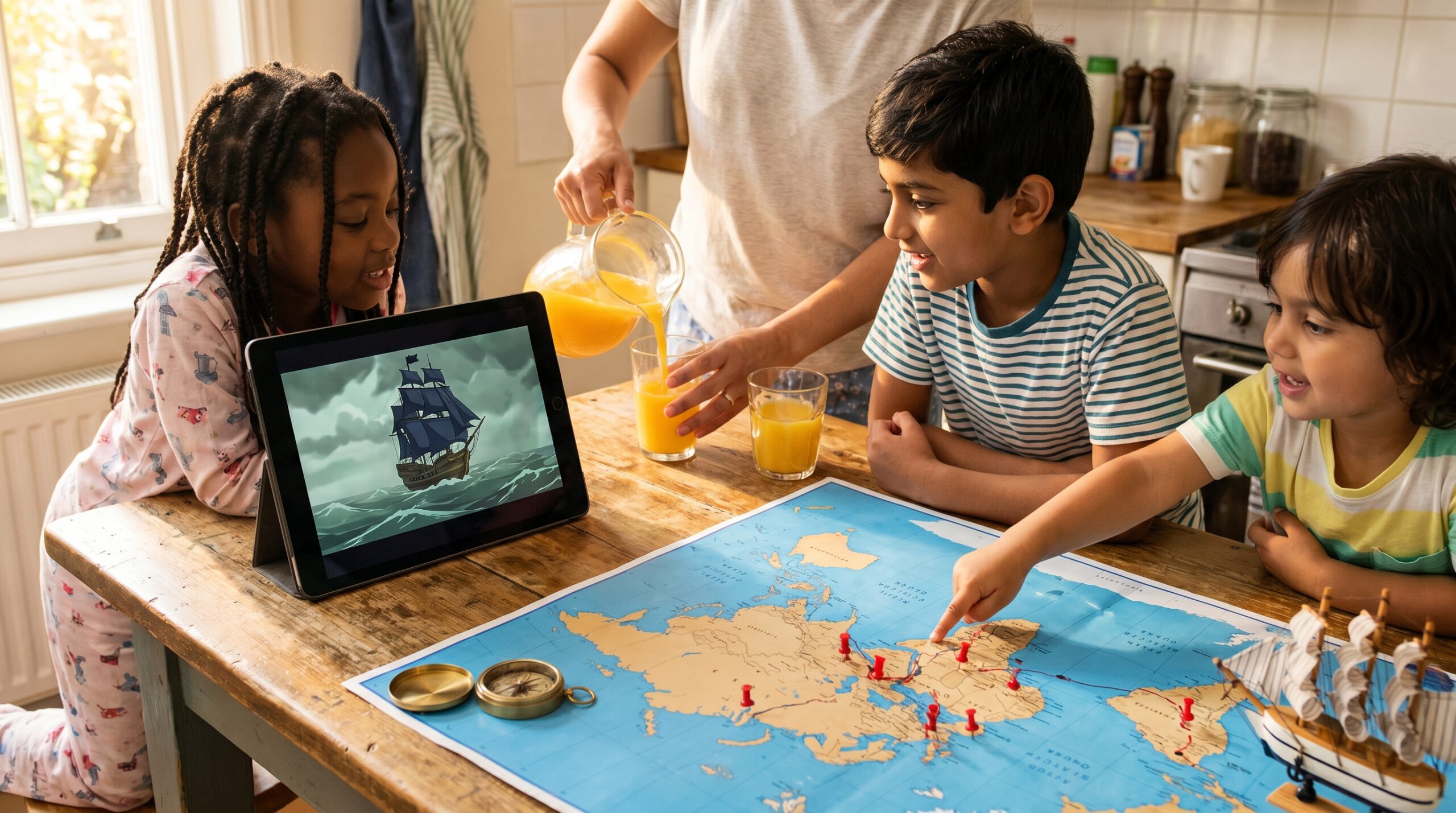
Keep it short and bright. For example, play a 10-minute sea clip at breakfast. Then point to a route on a map. Next, draw a tiny paper boat and say one new word. This simple activity sparks curiosity without overwhelm.
Read or listen to a story about Age of Discovery now: For 3-5 year olds, For 6-8 year olds, For 8-10 year olds, and For 10-12 year olds.
If you want more, visit Storypie for related stories and listening guides. These resources help parents and teachers present history with care.