I tell a tiny bedtime tale about Ancient India Indus Valley. I whisper about a child who finds a clay seal. We wonder what the pictures mean. Short sentences. Curiosity leads the rest.
What the Indus Valley was like
The Indus Valley civilization flourished about 2600 to 1900 BCE, but it lasted from approximately 3300 BCE to 1300 BCE. It grew along the Indus and nearby plains. Today the region lies in Pakistan, northwest India, and parts of Afghanistan. Cities such as Harappa and Mohenjo-daro feel surprisingly modern. They had grid streets and uniform baked bricks. I love that detail. It is a tiny treasure.
Daily life, crafts, and public spaces
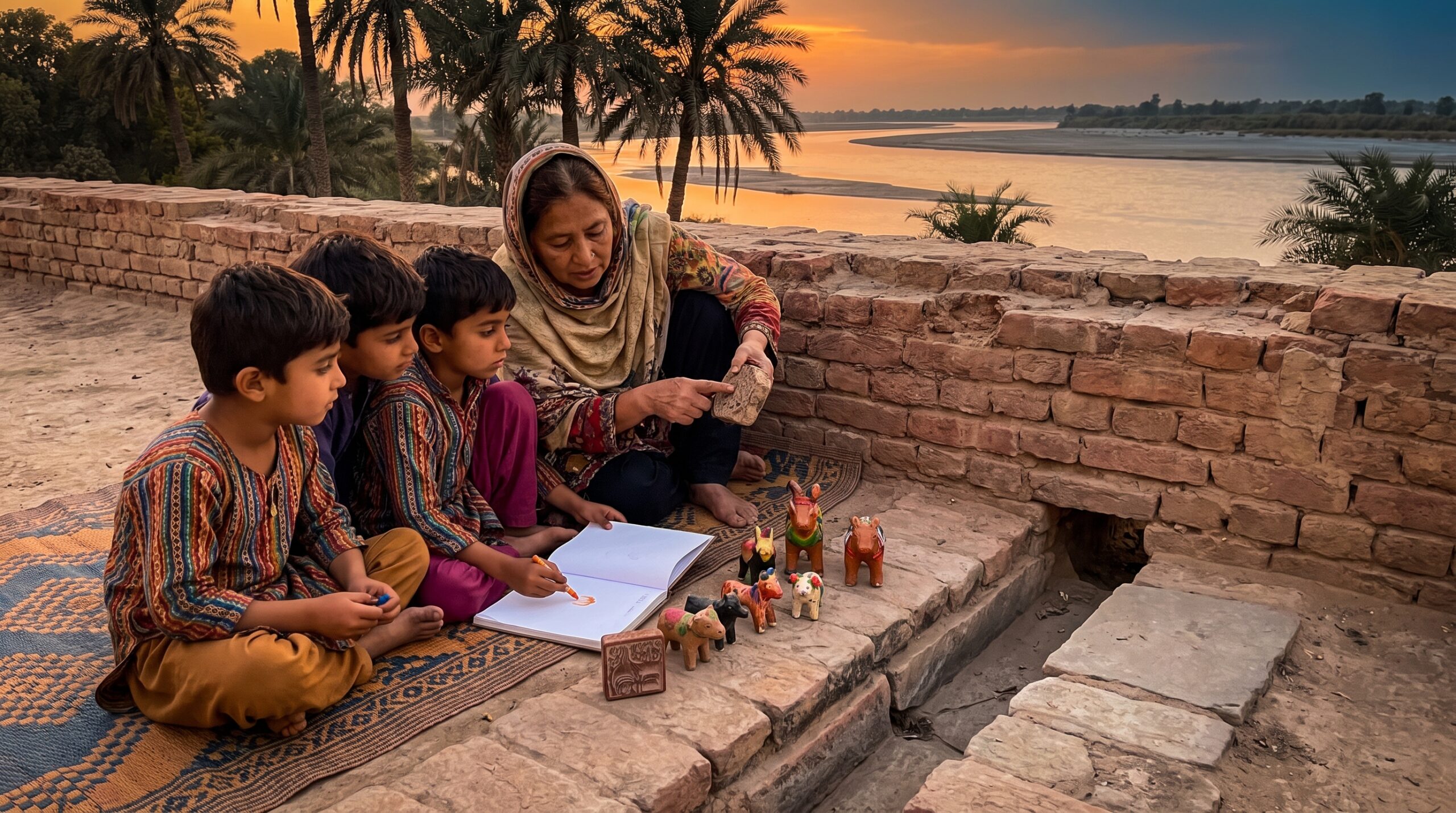
People built public baths and granaries. The Great Bath at Mohenjo-daro acted as a civic heart. Many houses had private wells and toilets. Those toilets fed into covered drains. Sanitation looks impressively advanced. Farmers grew wheat, barley, millet, and early cotton. Craftspeople made beads, pottery, bronze tools, and jewelry. Kids played with terracotta toys. The Dancing Girl bronze shows skilled metalwork. Standard weights and seals suggest organized trade. At its peak, the Indus Valley Civilization may have had a population of over five million people, showcasing its complexity.
City planning and water
Streets followed a rectilinear grid. Neighborhoods fit into blocks. Dholavira shows reservoirs and clever water work. Lothal hints at dockyards and maritime trade. Harappan objects traveled far. The civilization spanned approximately 1.3 million square kilometers, making it the largest ancient civilization. Mesopotamia called the region Meluhha. That name sounds wonderfully odd to a child.
Map and major sites
The core area stretched along the Indus and Ghaggar plains. It reached from eastern Afghanistan through Pakistan into northwestern India. Major sites include Harappa, Mohenjo-daro, Dholavira, Lothal, Rakhigarhi, and Mehrgarh. Over 1,000 Indus Valley Civilization sites have been discovered, but only 40 were known before the Partition of India and Pakistan. Some sites are UNESCO protected. New digs keep changing what we know. I point this out to older kids.
The mystery of the script
Seals with pictographs appear everywhere. Hundreds of short signs remain undeciphered. The people left no long texts. That makes the script a real puzzle. I ask my child to guess what a seal animal might mean. It sparks more questions. It keeps the wonder alive.
Simple family activities
- Draw one thing from the story: a toy, a seal animal, or the Great Bath.
- Build a tiny city with colored bricks to show streets and blocks. Ten minutes.
- Make a clay seal stamp. Press damp clay with a coin or leaf and make a print. Let it dry.
- Tell the story in first person: “I am the child who found the seal.” Record and save.
Read or listen to a story about Ancient India (Indus Valley) now: For 3-5 year olds, For 3-5 year olds, For 6-8 year olds, For 8-10 year olds, and For 10-12 year olds.
I love that small moment when a child points at a seal and asks, “Who lived here?” Tonight, ask them to draw the one thing they remember. Keep it short. Celebrate the attempt. It turns curiosity into a vote for more stories.