
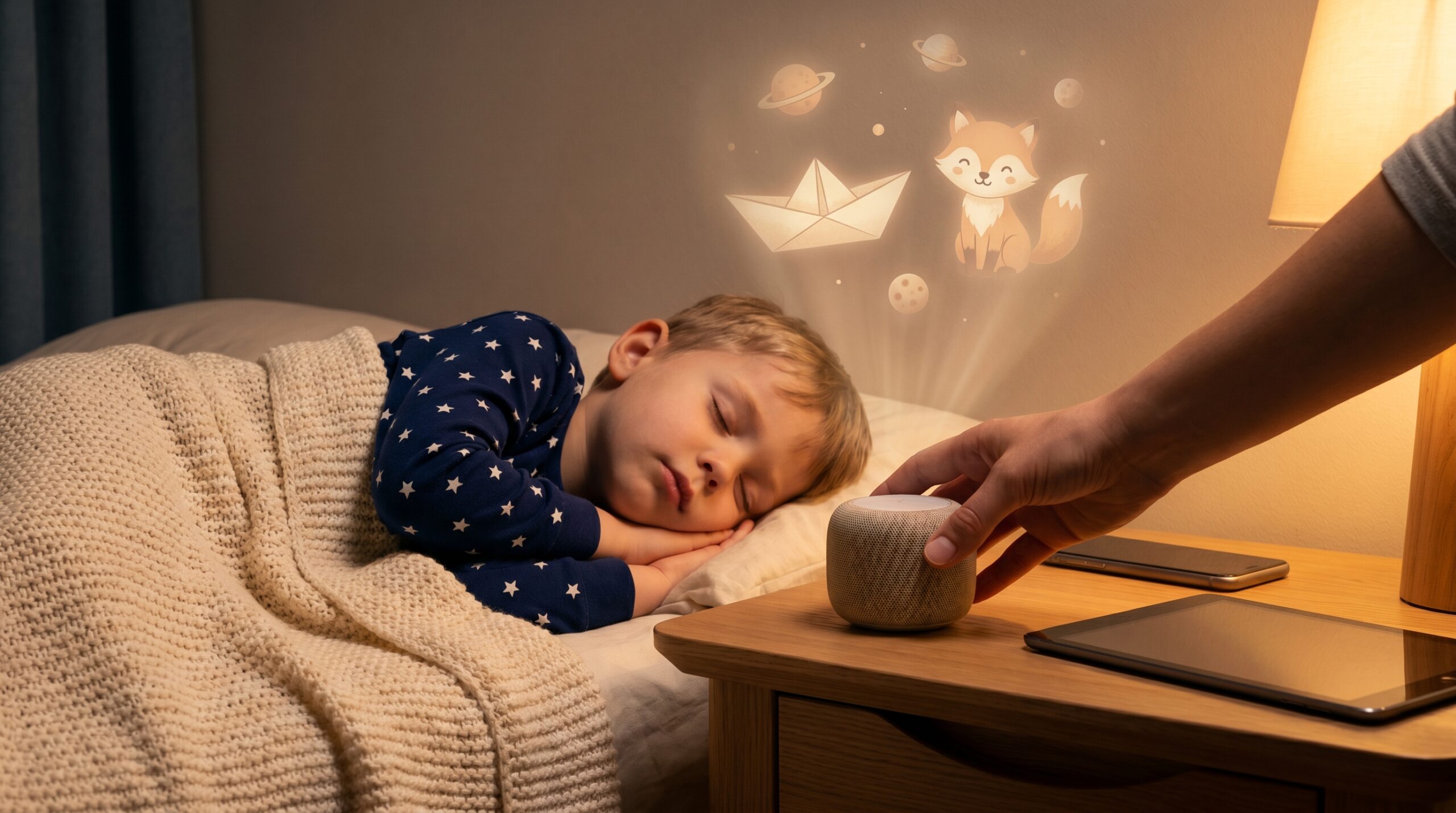
Audio-first storytelling cuts visual clutter and frees the mind to imagine. Parents and teachers see calmer evenings and richer play when they choose audio-first experiences.
Why audio-first storytelling eases cognitive load
Working memory holds only a few bits of information at once. Therefore, busy screens can split a child’s attention. When visuals compete with narration, kids lose focus and comprehension suffers. A 2024 study found that viewers reported significantly higher cognitive load when watching subtitled videos without sound, with mean Effort scores of 4.84 (sound OFF) compared to 3.07 (sound ON) on a 1–7 scale (p < .001).
Audio-first storytelling avoids that split. By keeping vision free, audio gives the brain room to build pictures. Research shows that neuroimaging can reveal distinct EEG oscillatory signatures for listening under sensory vs. cognitive load, indicating measurable neural markers for cognitive effort during complex listening, as reported in NeuroImage. As a result, children follow plot, feel emotions, and remember details more easily.
How audio-first boosts imagination and language
Neuroimaging finds that listening lights up the same sensory areas used for seeing and feeling. In short, hearing a tale helps children create vivid inner scenes. A 2024 study demonstrated that EEG-based cognitive load estimation achieved a peak F1-score of 0.98 when assessing psychoacoustic parameters, indicating a strong correlation between audio characteristics and cognitive load.
Also, rich narration exposes kids to new words and sentence rhythms. That exposure supports vocabulary growth and later reading. Audio-first experiences encourage children to act out stories, invent endings, and rehearse social scripts.
Bedtime benefits of audio-first
Screens emit blue light and quick edits that raise arousal. In contrast, a short audio story avoids those problems. A calm ten-minute story often helps settle bodies and quiet minds.
For many families, audio-first becomes the simplest ritual. Dim the lamp, tuck in a blanket, and let the voice lead. The routine signals rest, so children drift toward sleep more easily.
Accessible and inclusive by design
Audio-first lowers barriers for children with visual impairments or reading differences. It also fits many ages. Short, paced narratives work for toddlers. Longer tales suit older kids.
Caregivers add value by co-listening or asking one gentle question. These small acts deepen understanding and connection.
Quality and practical tips
Quality voice work, clear pacing, and spare sound design matter most. Avoid jarring effects and loud transitions. Also, match language to age and keep volumes low.
For bedtime, aim for stories that run five to fifteen minutes. Finally, stay present for the youngest listeners and let the quiet follow the tale.
Make audio-first part of your evening
Audio-first storytelling blends ancient habit with modern design. It reduces clutter, supports imagination, and creates calmer nights. A 2024 Educational Psychology Review paper found 83% of 191 undergraduates reported watching lecture videos at speeds >1×, and experimental results showed comprehension begins to suffer beyond ~2× playback, reinforcing the value of audio-first strategies. Try swapping one screen for a short audio story tonight.
Explore calming tales and tiny rituals at Storypie stories. Or, get started by downloading the app at Get the Storypie app.