Blaise Pascal for kids introduces a curious child who grew into a clever inventor and deep thinker. Born on June 19, 1623, in Clermont-Ferrand, France, Pascal loved puzzles, small machines, and big questions. His life blends math, gadgets, experiments, and thoughtful writing.
Blaise Pascal for Kids: Early life and curiosity
Pascal showed promise very early. His father, Etienne, moved the family to Paris to support his studies. Then Blaise studied geometry and wrote about conic sections while still a teen. For example, he solved hard problems with surprising ease. People called him a child prodigy, and understandably so.
Playful curiosity leads to learning
Pascal liked puzzles and hands-on work. Also, he loved to tinker with small machines. His curiosity felt like a bright, steady flame that shaped his life.
Inventions and experiments
At about 19 years old, in 1642, Pascal built the Pascaline, an early mechanical adding machine designed to assist his father with tax computations. It used gears and wheels to add and subtract numbers. Picture tiny cogs clicking as numbers carried from wheel to wheel. By 1654, he had sold about 20 of these machines, of which only 9 are known to exist today. This tool showed how clever design can solve everyday problems.
Pascal also studied air and pressure. For instance, he repeated Torricelli’s barometer tests and conducted atmospheric pressure experiments on Puy-de-Dôme in 1648. His work demonstrated that atmospheric pressure decreases with altitude; at the base, the mercury column measured 26 inches plus 3½ lines, while at the top (about 1000 m higher), it measured 23 inches plus 2 lines. Moreover, Pascal described how pressure moves through fluids. Today, Pascal’s law helps explain hydraulic machines and pumps.
Math, probability, and ideas
Pascal explored patterns that appear in Pascal’s triangle. Then he wrote letters with Pierre de Fermat about gambling puzzles. As a result, their work helped start modern probability. In fact, Pascal’s work laid the foundation for the modern theory of probabilities, significantly influencing the development of modern economics and social science. These ideas grew from play and careful thought.
Later in life, Pascal turned more to religion and reflection. He wrote short, powerful pieces that we know as Pensées. One well-known idea from this collection is Pascal’s Wager. These writings show the same curious mind in a quieter mood.
Legacy: why he still matters
Pascal left many marks that we still notice today. For example, the SI unit pascal measures pressure; this name was officially adopted by the 14th General Conference on Weights and Measures in 1971. Also, a programming language bears his name. His ideas link math, machines, and curiosity in ways that still surprise us.
Read or listen to a story about Blaise Pascal now: For 3-5 year olds, For 6-8 year olds, For 8-10 year olds, and For 10-12 year olds.
Simple ideas to share tonight
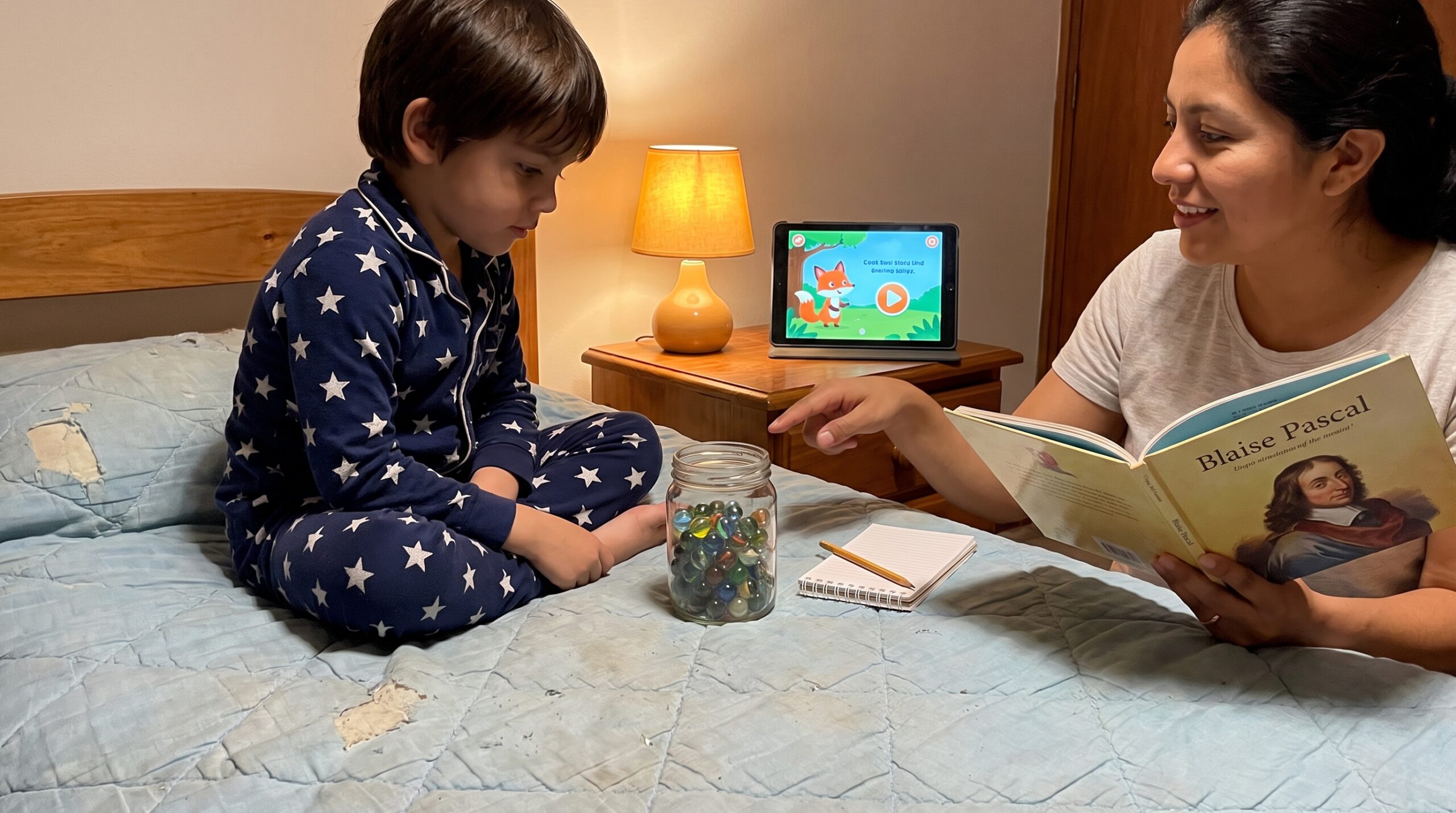
Tell children that Blaise Pascal loved asking small questions that led to big answers. Then try a tiny experiment under adult supervision, like guessing how many marbles fit in a jar and counting together. These small moments bring Pascal’s curiosity to life.
Also, explore more stories and audio on Storypie to keep the wonder alive: Storypie. Finally, Pascal reminds us that playful questions can change the world.