
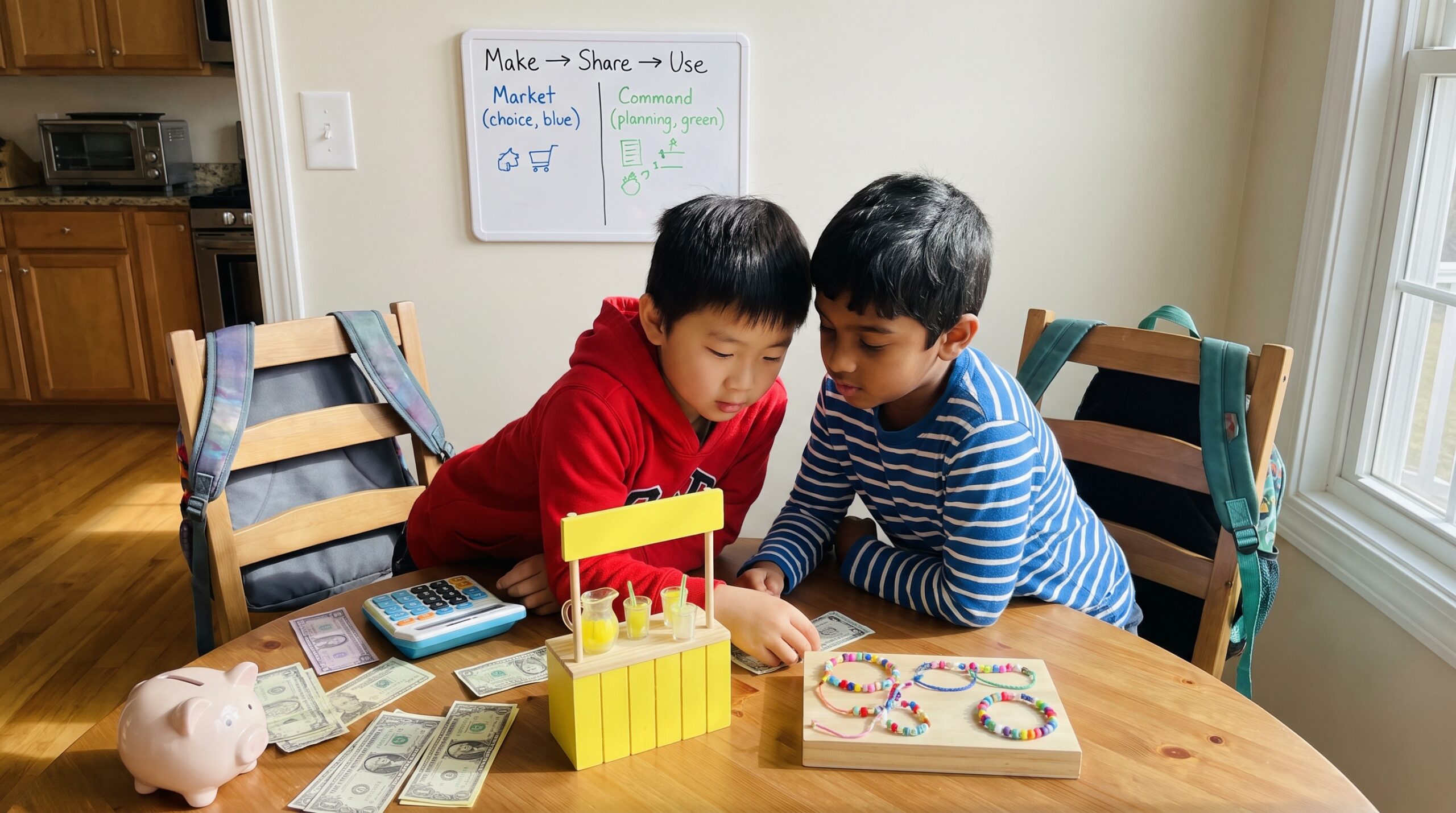
Economic systems market vs command economies explain how a society decides what to make, how to make it, and who gets it. This family-friendly guide makes the idea simple and playful for parents and teachers.
What economic systems mean at home
In a market economy, choices come from people. Buyers and sellers set prices by supply and demand. Also, private property, competition, and profit motive steer decisions. Imagine a lemonade stand. If many kids buy lemonade at one price, other stands appear with new flavors or lower prices. Prices tell sellers what to make. Markets shine at encouraging innovation and matching what people want.
What a command economy looks like
In a command economy, a central planner or government sets output, prices, and distribution. For example, think of a classroom where the teacher assigns one table to bake muffins. Then every child gets the same slice. Planners can direct resources quickly and aim for fairness. However, planners may miss what people actually want. As a result, shortages or surpluses can happen. In fact, as of 2024, there are approximately 33,834 state-owned enterprises (SOEs) globally, employing around 43 million people and holding combined assets of nearly USD 141 trillion, which is equivalent to about 126% of global GDP, highlighting the significant impact of command economies on the global stage, according to OECD data.
Most countries use mixed systems
Most nations use mixed economies. That means markets handle many choices while governments regulate and provide public services. For instance, the United States leans market-oriented. Meanwhile, Nordic countries combine markets with strong welfare. History shaped these choices. Ideas from Adam Smith and Karl Marx changed how countries shifted between market systems and planned economies over the last two centuries. Notably, between 2013 and 2024, the number of large non-financial SOEs worldwide increased dramatically from 9,584 to 26,068, and their total assets nearly doubled in real terms, reinforcing the growing influence of command economies in the global market, as noted by OECD research.
How prices and planning work, simply
- Market signal: a high price shows strong demand or scarce supply. Producers then make more.
- Planner rules: central plans set quotas and allocation rules. They can guarantee basics but may not match tastes.
Everyday effects for families
Taxes, regulations, and services shape daily life. Markets make many products available fast. But governments fund schools, roads, and safety nets. Also, both systems must handle public goods and environmental issues. Markets may underprice pollution unless rules fix that. In contrast, command systems can mandate change but may lack clear incentives to innovate. Interestingly, as of 2023, companies with more than 25% public sector ownership accounted for nearly 12% of global market capitalization, amounting to 2,037 companies—this showcases the blend of market and command economies in today’s economic landscape according to OECD findings.
Quick takeaways for families
- Market strengths: efficient, inventive, and responsive to shoppers.
- Command strengths: can focus on equity and rapid mobilization.
- Trade-offs exist: freedom versus equality, growth versus stability.
Short family activity
Try a five-minute prompt after school. Ask your child to choose between two tiny business ideas. For example, selling cookies after school or offering ten-minute homework help. Ask, Who would buy it? How much will you charge? What do you need to start? A brief chat like this explains consumers, costs, and choice in a playful way.
Read or listen to a story about Economic Systems (Market vs. Command Economies) now: Read or listen to a story about Economic Systems (Market vs. Command Economies) now: For 3-5 year olds, For 6-8 year olds, For 8-10 year olds, and For 10-12 year olds.
Explore more learning tools and family prompts at Storypie. Finally, systems reflect history, values, and choices. Asking questions together helps children see trade-offs and grow into thoughtful decision makers.