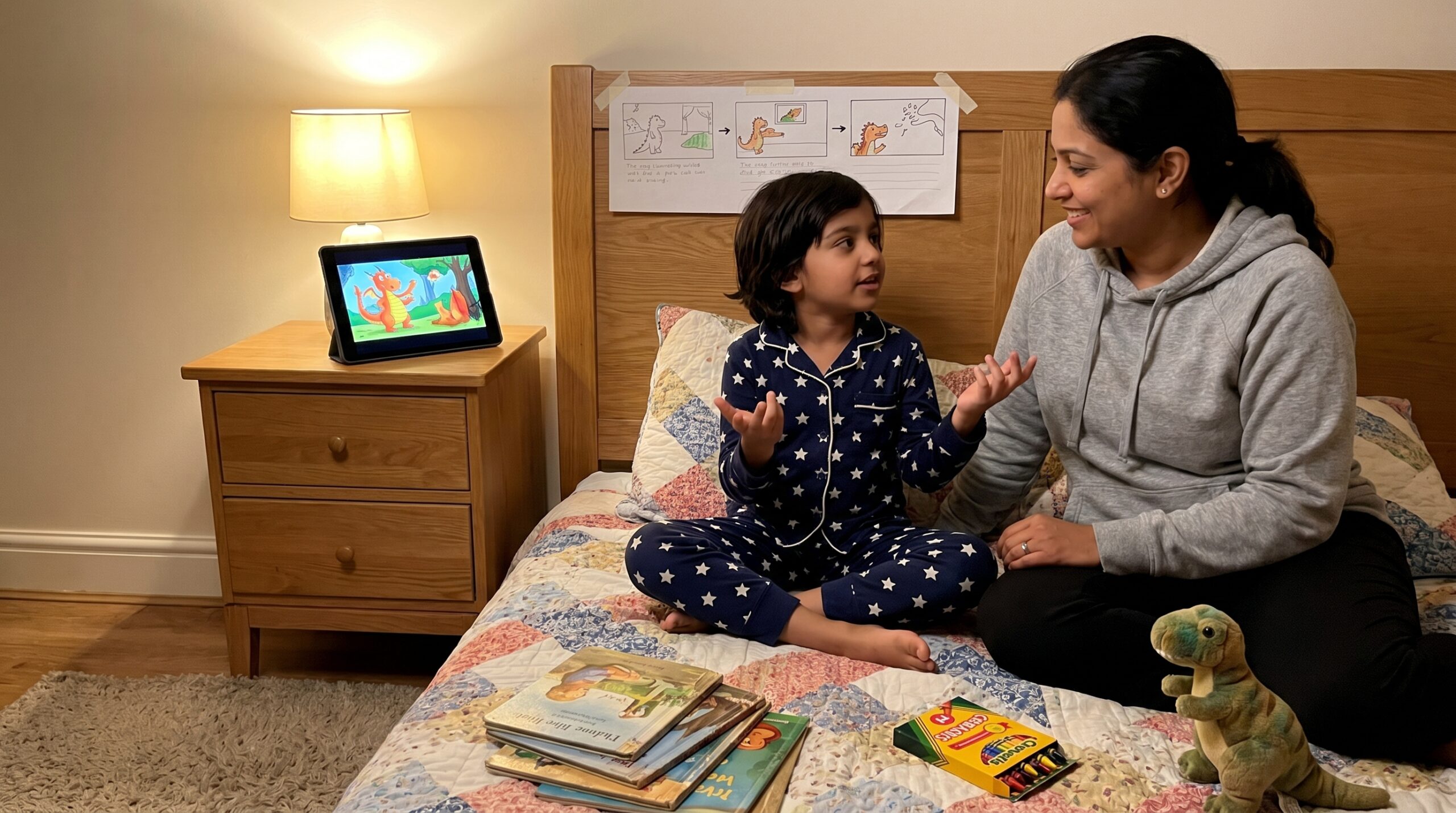
Education through storytelling ages 3-12 helps facts stick. Parents and teachers see children lean in and remember more. Tonight, try one short retell and watch learning grow.
Why education through storytelling ages 3-12 works
Stories bundle cause and effect. They add feeling and meaning. As a result, memory and emotion fire together. Neuroscience shows narrative lights up both memory and emotion centers. So children do not just remember facts. They remember people, actions, and feelings. In fact, a 2025 meta-analysis found that interactive/shared reading produced a moderate aggregate effect on young children’s narrative ability, particularly benefiting 4–5-year-olds.
Old but powerful
People told stories long before writing existed. For generations, oral tales passed skills and rules. They also kept identity and culture alive. Today, we still use stories in picture books, chapter books, and apps. Each format keeps the same core power.
How narrative maps to ages 3 to 12
Children change fast. Narrative shifts with them. Below are simple, stage-friendly notes.
- Ages 3 to 5: Young children learn sequence and simple cause and effect. Short, rhythmic tales with clear outcomes work best. A 2023 study indicated that storytelling in early childhood is associated with significantly higher developmental odds in literacy and numeracy.
- Ages 6 to 8: Attention grows. Kids follow multi-step plots and infer motives. Short chapters and clear problems help transfer ideas to school tasks. For example, a 2024 study involving fourth graders showed that the storytelling group achieved significantly higher post-test scores compared to a control group.
- Ages 9 to 12: Older children handle complex causes and multiple perspectives. Deeper stories support moral reasoning and broader concepts. A 2023 meta-analysis confirmed that storytelling-based science education is a highly effective method for teaching young children science concepts.
Where education through storytelling ages 3-12 shows up in school
Teachers use stories to teach vocabulary, comprehension, and writing. The curriculum often highlights listening and storytelling skills. Therefore, narrative is not just charming. It is educationally strategic and classroom-ready. A 2024 meta-analysis found that narrative learning materials produced a statistically significant positive effect on academic performance compared to expository materials.
Caregivers, formats, and small guardrails
Your voice matters. Shared reading adds emphasis and gentle scaffolding. Consequently, adult-led reading boosts learning far more than solitary reading.
Digital formats can help when they keep sequence and emotion intact. For example, audiobooks and apps make stories easy to replay. Try a partner app like Storypie to save family tales and build a small library.
Quick guardrails
- Timebox to ten minutes. Short wins beat long lectures.
- Offer two clear choices, not a dozen.
- Celebrate attempts. Praise curiosity, not perfection.
Try one short retell tonight
Pick a spark your child mentioned today. Set a tiny goal, like six sentences. Co-create the beats: problem, try, oops, learn, share. Speak or record it. Hearing themselves helps recall and pride.
Save the story in a family library. For a gentle partner, find bedtime stories on Storypie and try the app tonight.
Stories are conversation, not a file dump. Use them and you give your child a handle on facts, feelings, and meaning. Try tonight and see how one small retell becomes a big learning moment.