
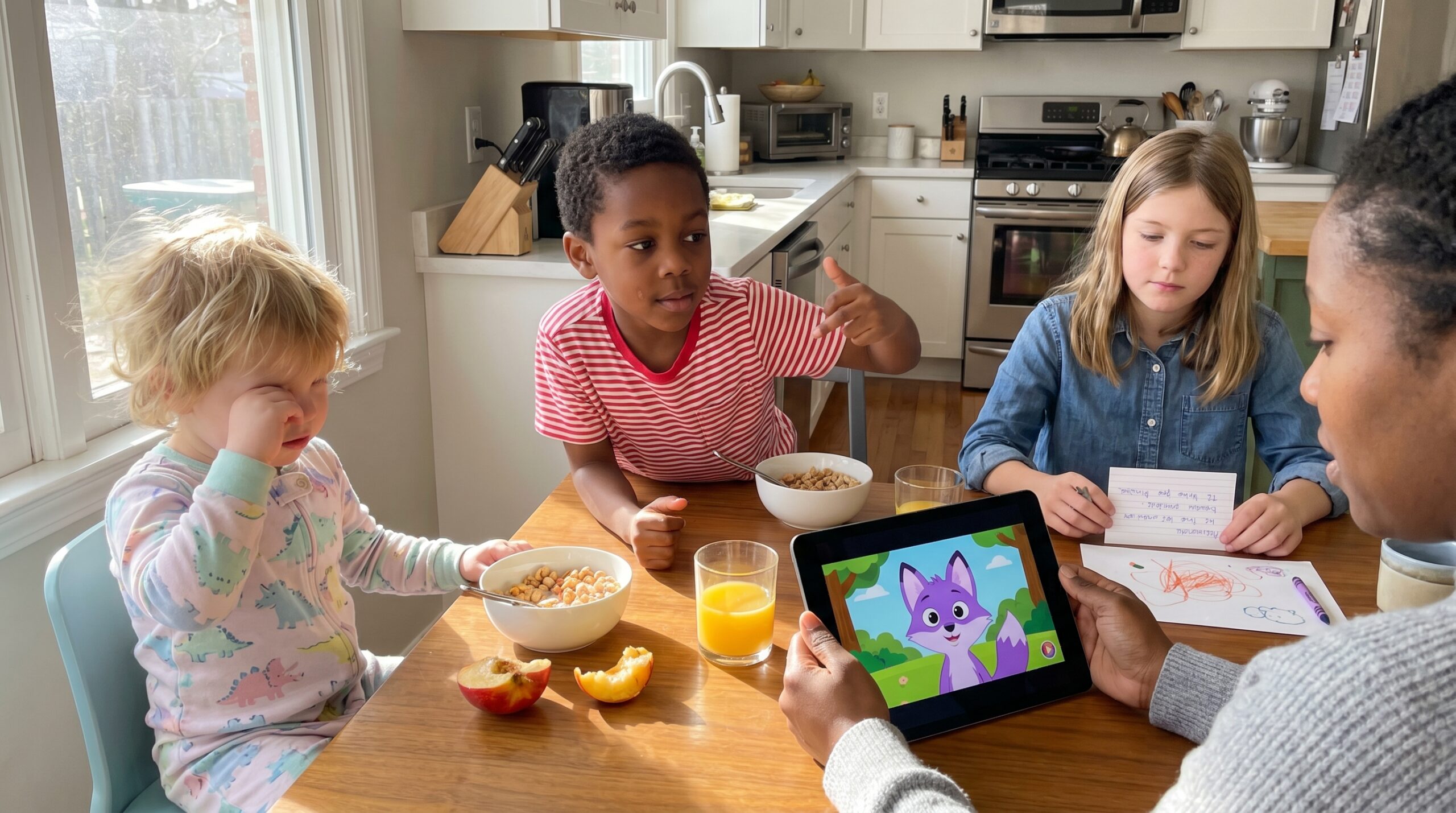
Education through storytelling ages 3-12 helps children remember ideas, grow vocabulary, and practice social thinking. At Storypie we use short, character-led tales to support development. These friendly stories act like memory hooks that last.
Education through storytelling ages 3-12: why narrative works
Stories order events. They show cause and effect. They give characters that children can follow. As a result, ideas become easier to hold in mind. Research indicates that storytelling increases information retention by 65% compared to traditional verbal instruction methods, making it a compelling argument for its use in education.
Stories also turn the abstract into the concrete. For example, a tale about a lost toy teaches problem solving. A brave mouse can stand in for courage. Research finds that children learn more new words from stories than from lists. A 2023 systematic review and meta-analysis of storytelling-based science education in early childhood reported a very large overall effect size of 1.345 for storytelling-based science education for young children, highlighting the significant impact storytelling can have on children’s understanding of scientific concepts, reinforcing its educational value.
Developmental fit by age
Ages 3 to 5 respond to simple plots and big feelings. They like clear problems and quick resolutions.
Ages 6 to 8 can follow more steps and cause-effect chains. They enjoy repeatable patterns and recurring language. A 2025 meta-analysis found that interactive/shared reading produces a medium aggregate improvement in young children’s narrative ability, which is crucial for their educational development.
Ages 9 to 12 handle longer arcs and subtler themes. They notice nuance and layered motives. Match length and tone to attention and age.
What children gain
Education through storytelling ages 3-12 supports several key skills. Children gain vocabulary and listening comprehension. Their episodic memory grows as they recall events. Empathy increases as kids hear characters think and feel. A longitudinal study published in May 2024 found that storytelling connectedness in children ages 5–8 predicted phonological awareness and reading comprehension measured 3–4 months later, showing the long-term benefits of storytelling on essential literacy skills.
- New words appear in context, so meaning sticks.
- Repeated characters and serial episodes reinforce language over time.
- Emotion words and perspective-taking emerge naturally in stories.
When story programs run consistently, studies show measurable gains on vocabulary and social measures. In short, narrative is both ancient and effective. A 2025 neuroimaging study tested 51 children (ages 6–12) and found that listening to a chapter of *Alice’s Adventures in Wonderland* activated canonical theory-of-mind brain regions, showing that narrative listening engages social-cognitive neural networks in children, further emphasizing storytelling’s role in enhancing social-cognitive skills, which are vital for children’s development.
Formats and accessibility
Stories arrive in many forms. Picture books pair images with text. Audio read-alouds invite imagination. Short episodic apps fit busy days.
Captions and translations widen access for multilingual homes. High quality, diverse content produces the strongest benefits. Low-quality or passive viewing reduces the gains.
Quality, equity, and Storypie
Quality matters most. Age-appropriate stories with diverse voices yield the best learning. Storypie curates short, character-led episodes that suit ages 3 to 12. Our content aims to be clear, kind, and memorable.
For parents and teachers who want ready-made episodes and gentle prompts, consider exploring Storypie. Visit the Storypie homepage or get the app to browse age groups and series.
Measuring small wins
Keep track of new words and one comprehension question. After two weeks, note which words your child uses. Small records reveal real progress and keep the work joyful.
Education through storytelling ages 3-12 builds curiosity over time. Delight follows. Practice is the point.