
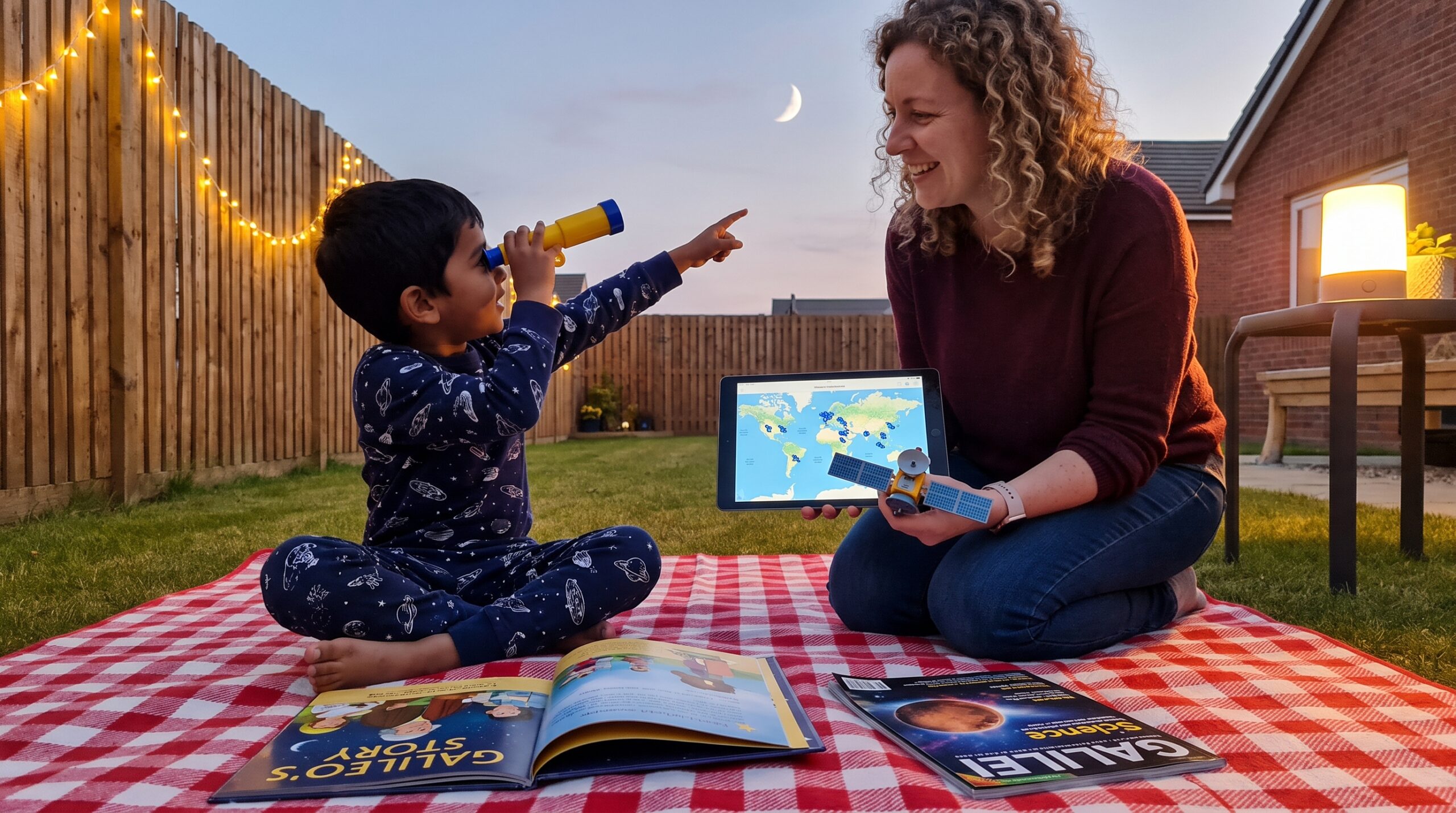
Galileo Galilei biography for kids opens a door to wonder. He was born on February 15, 1564 in Pisa and died on January 8, 1642 at age 77 in Arcetri. Galileo was a mathematician, astronomer, and an experimental thinker. He kept asking small questions that led to big changes.
Read or listen and start a small night of wonder
Read or listen to a story about Galileo Galilei now: For 3-5 year olds, For 3-5 year olds, For 6-8 year olds, For 8-10 year olds, and For 10-12 year olds.
Galileo Galilei biography for kids: Major discoveries
Around 1609 Galileo improved refracting telescopes and used them to see the sky in new ways. In 1610 he published Sidereus Nuncius and shared exciting findings. He saw mountains and craters on the Moon. He counted countless faint stars in the Milky Way. He found four moons orbiting Jupiter. He watched the phases of Venus and recorded sunspots. These observations helped people accept the Sun centered model of the solar system.
Simple list of discoveries
- Moon mountains and craters
- Many faint stars in the Milky Way
- Four Galilean moons of Jupiter
- Phases of Venus and sunspots
Physics and experiments
Galileo did more than look up at the sky. He rolled balls down inclined planes to study motion. He showed that distance grows with the square of time under uniform acceleration. He argued for inertia, a key idea later used by Newton. His book Two New Sciences from 1638 collected these ideas and influenced later physics.
Conflict, consequence, and myths
Galileo supported Copernican ideas in his Dialogue of 1632. The Roman Inquisition tried him in 1633. He was found “vehemently suspect of heresy” and was forced to recant. He spent the rest of his life under house arrest. However, he kept working and published important results while confined. Many stories about him are exaggerated. For example, he did not invent the telescope and the famous phrase “E pur si muove” is likely apocryphal.
Family activities to spark observation
These short, playful ideas connect children to Galileo’s curiosity. Try one tonight and make it magical.
- Moon watch: Spend 10 minutes. Look near the terminator and notice shadows and craters. Draw what you see.
- Jupiter spot: With binoculars or a small telescope look for tiny points beside Jupiter. They are its largest moons.
- Nightly change: Watch the Moon several nights and note how its shape changes.
Safety note: Never look at the Sun without a proper solar filter and adult supervision.
Short timeline
- 1564: Born in Pisa
- c.1589 to 1592: Teaching at Pisa and Padua
- 1609 to 1610: Telescope improvements and discoveries
- 1610: Sidereus Nuncius published
- 1632: Dialogue published
- 1633: Trial and house arrest
- 1638: Two New Sciences
- 1642: Died in Arcetri
Galileo Galilei biography for kids shows curiosity, careful observation, and gentle testing of ideas. These are skills that children can practice tonight. For more child friendly stories and narrated readings, visit Storypie and explore our Galileo content.
What will your child notice first? A short night of looking can start a lifetime of curiosity.