
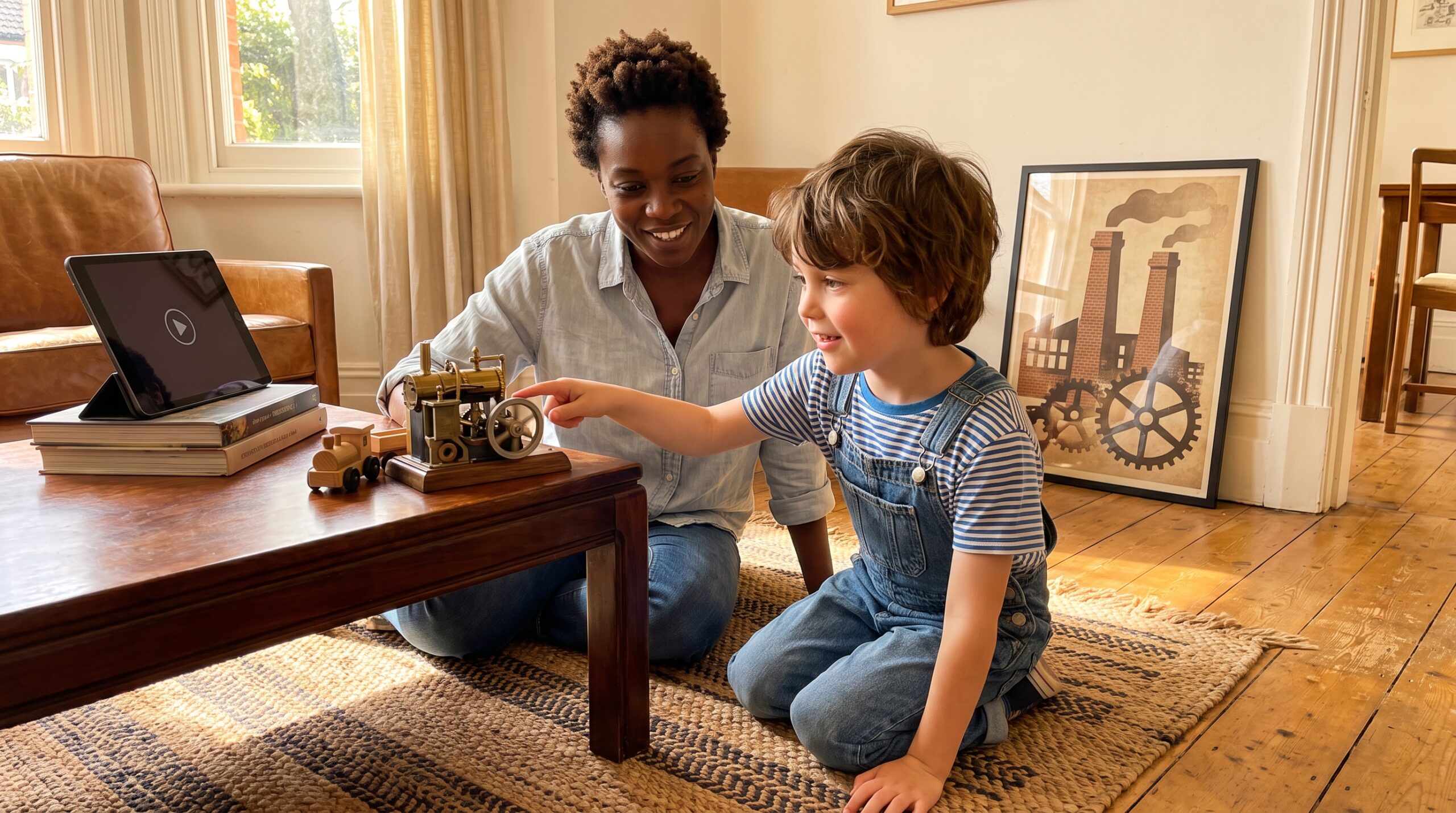
The Industrial Revolution for kids is a story of machines, towns, and big change. It began in Britain in the mid 1700s and continued through the 1800s. For parents and teachers, this clear guide explains key events, inventions, and everyday effects in plain language.
Why it started
Historians link the start to coal, iron, better farming, and growing towns. Also, new investment and curious inventors sped progress. James Watt improved the steam engine. James Hargreaves made the spinning jenny. Richard Arkwright built the water frame. Additionally, Edmund Cartwright created the power loom. These inventions changed how cloth was made and who made it. By the mid-1810s, cotton exports constituted 42% of the total value of British exports, highlighting the cotton industry’s significance during this time.
Key inventions and transport
Early locomotives moved goods and people faster. For example, Richard Trevithick and George Stephenson built early steam engines. Moreover, the Stockton and Darlington line opened in 1825. Next, the Liverpool and Manchester railway followed in 1830. Later, the telegraph and the Bessemer steel process added speed and strength after the 1850s. In the U.S., coal production exploded, increasing from 1,008 thousand tons of anthracite and 552 thousand tons of bituminous coal in 1839 to 60,418 thousand tons anthracite and 193,323 thousand tons bituminous by 1899, demonstrating the demand for coal as a critical resource for industrial growth.
Short timeline
- Mid 1700s: textile and steam innovations
- Late 1700s to early 1800s: factories, canals, and coal mining
- 1820s–1830s: railways and telegraph spread
- Mid 1800s and later: steel, electricity, and international spread
Energy, factories, and work
Power shifted from water and hands to coal and steam. Consequently, factories gathered machines and workers under one roof. This system created set hours and a division of labour. It made many goods faster and cheaper. However, work could be long and dangerous. Also, child labour was common. As a result, reforms followed. For instance, the Factory Acts began in the 1830s. Likewise, public health laws like the 1848 Public Health Act aimed to improve safety and living conditions. By 1851 in Britain, industrial employment comprised 33.3% in manufacturing, 4.5% in construction, and 3.1% in mining, showing a significant shift in the labor market due to the Industrial Revolution.
Everyday life and lasting change
Mass production changed clothing, cooking, and play. Cheaper cloth meant more clothing choices. Canned food grew more common. Towns expanded around mills and mines. Britain’s coal production increased from 64.7 million long tons in 1854 to 110.4 million long tons by 1870, underscoring the importance of coal in powering industrial growth. Today, museums and preserved mills show these changes in friendly exhibits. They help families picture past lives and noisy machines.
Small glossary
- Factory: a place where machines and people make goods
- Steam engine: a machine using steam to do work
- Industrialisation: the building of factories and machines
- Urbanisation: people moving to towns and cities
Final thought
The Industrial Revolution shaped modern life in bright and challenging ways. It changed work, travel, and shopping. Also, it started debates about fairness and safety that still matter. For a gentle way to explore this topic with children, visit Storypie for short stories and listening options. Between 1860 and 1900, approximately 14 million immigrants arrived in the United States, providing a substantial labor force for various industries, which further highlights the impact of this period on society.
Read or listen to a story about Industrial Revolution now: For 3-5 year olds, For 6-8 year olds, For 8-10 year olds, and For 10-12 year olds.
Explore more at Storypie to match the reading level and curiosity of your child. Enjoy a short listen together.