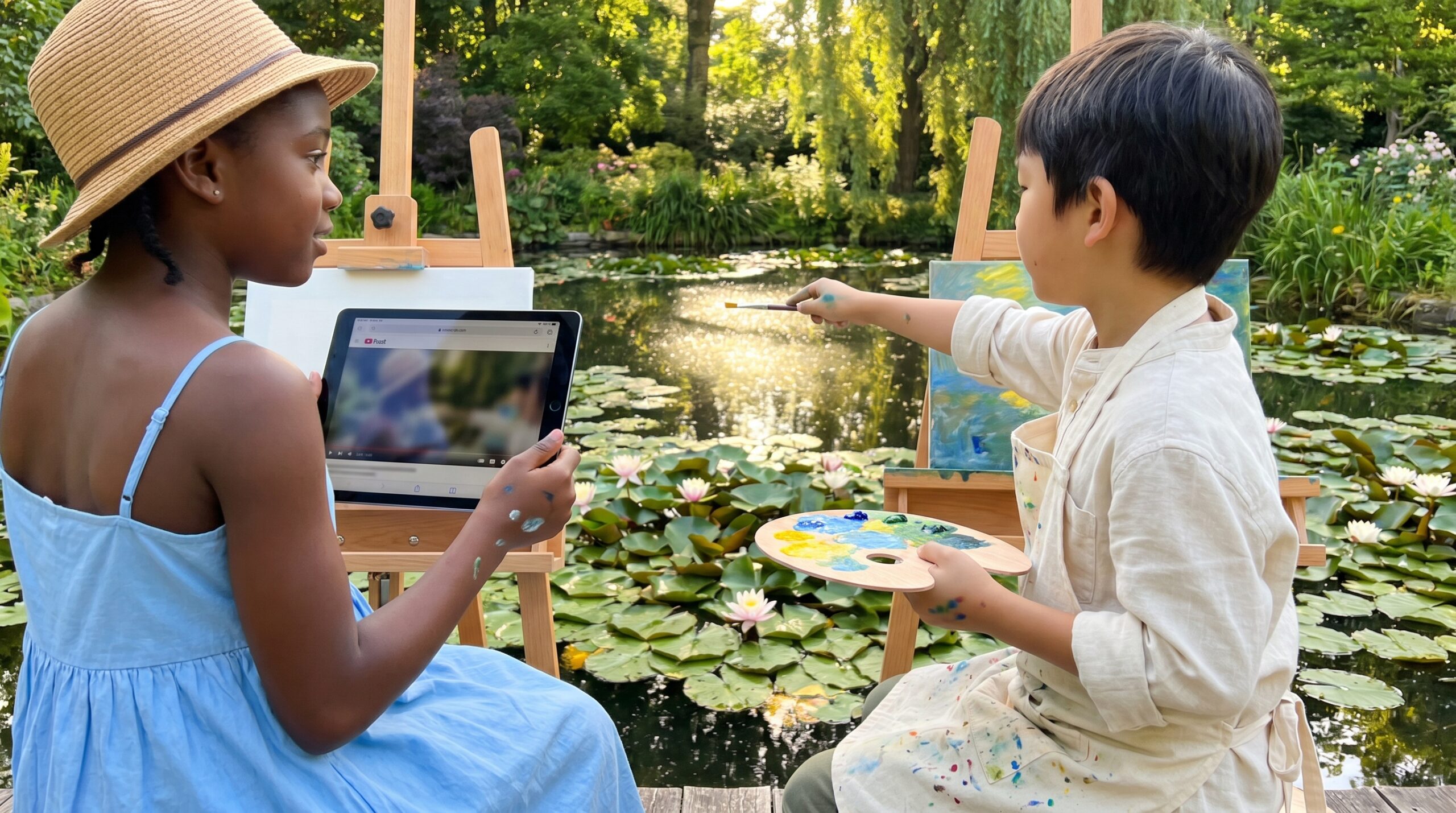
Post-Impressionism for kids opens a bright door to color, shape and big feelings. It invites close looking and joyful surprise. Short stories and tiny experiments help ideas stick like candy for the brain.
Read or listen to a story about Post-Impressionism now: Read or listen to a story about Post-Impressionism now: For 3-5 year olds, For 6-8 year olds, For 8-10 year olds, and For 10-12 year olds.
What is Post-Impressionism for kids?
Post-Impressionism grew in late 1800s France. Artists loved modern life and bright color. However, they wanted stronger structure, mood and meaning. The label came later from critics. Thus, it does not name a single club. Instead, it groups creative cousins with different tools. In recent years, the Post-Impressionism art market has experienced fluctuations; for instance, in 2024, sales of Impressionist and Post-Impressionist art declined by 17% to $1.2 billion, nearly one-third lower than pre-pandemic levels in 2019, according to The Art Basel & UBS Art Market Report 2025.
Artists and quick notes
Here are short, playful notes to share with children. Each line is a tiny anchor for looking.
- Vincent van Gogh. Look for thick swirls and bold strokes. Say one short stroke is joy. The brushwork feels like a song.
- Paul Cezanne. See the blocky shapes. He built form like simple blocks. That idea helped lead to Cubism.
- Georges Seurat. Tiny dots make a full picture from afar. Try a dot with a cotton swab and then step back to see the magic.
- Paul Gauguin. Notice flat, bold colors and clear outlines. His colors often carry stories and symbols.
- Henri de Toulouse-Lautrec. Look for bold outlines and lively city scenes. His posters made art public and playful.
Simple, fast activities
Try one short activity tonight. Each idea takes ten focused minutes or less.
- Name the light. Point to a light spot and ask a child to name its color in one word. This trains noticing.
- Dot picture. Use cotton swabs or stickers to make a sun or park. Step back and watch the dots mix in the eye.
- Bold shapes and outlines. Give two crayons. Fill big flat shapes and trace them in black. Clap for brave color choices.
- Swirl stroke. Use thick crayon or paint. Make a short swirl and name its feeling: storm, joy, whisper.
Where to see Post-Impressionism
Major museums hold great examples. For instance, the Van Gogh Museum and Musée d’Orsay contain anchors for looking. Notably, the Van Gogh Museum reported a total of 1,842,742 visitors in 2024, showcasing the popularity of Post-Impressionist art. In addition, national galleries and art museums often show masterpieces. The Musée d’Orsay, which holds the world’s largest Impressionist and Post-Impressionist collection, reported welcoming over 3,871,400 visitors in 2023, reflecting significant interest and engagement with this cultural treasure. Visiting helps link names to visuals and feeling.
Why Post-Impressionism matters
Post-Impressionism connects Impressionism to later styles like Fauvism and Cubism. Its artists experimented with color, form and mood. Therefore, this period shaped much of modern art. For parents and teachers, Post-Impressionism for kids makes looking playful and curious. It turns seeing into a small, delightful game. Moreover, despite the recent decline in sales value, the number of Impressionist and Post-Impressionist lots sold at auction increased by 13% year-on-year in 2024, marking the second consecutive year of growth in transaction volume, according to The Art Basel & UBS Art Market Report 2025. This indicates a resilience in the market that speaks to the enduring appeal of these artistic movements.
For a gentle follow up, explore more Post-Impressionism stories on Storypie. Visit Storypie to browse related concepts and age-specific tales.