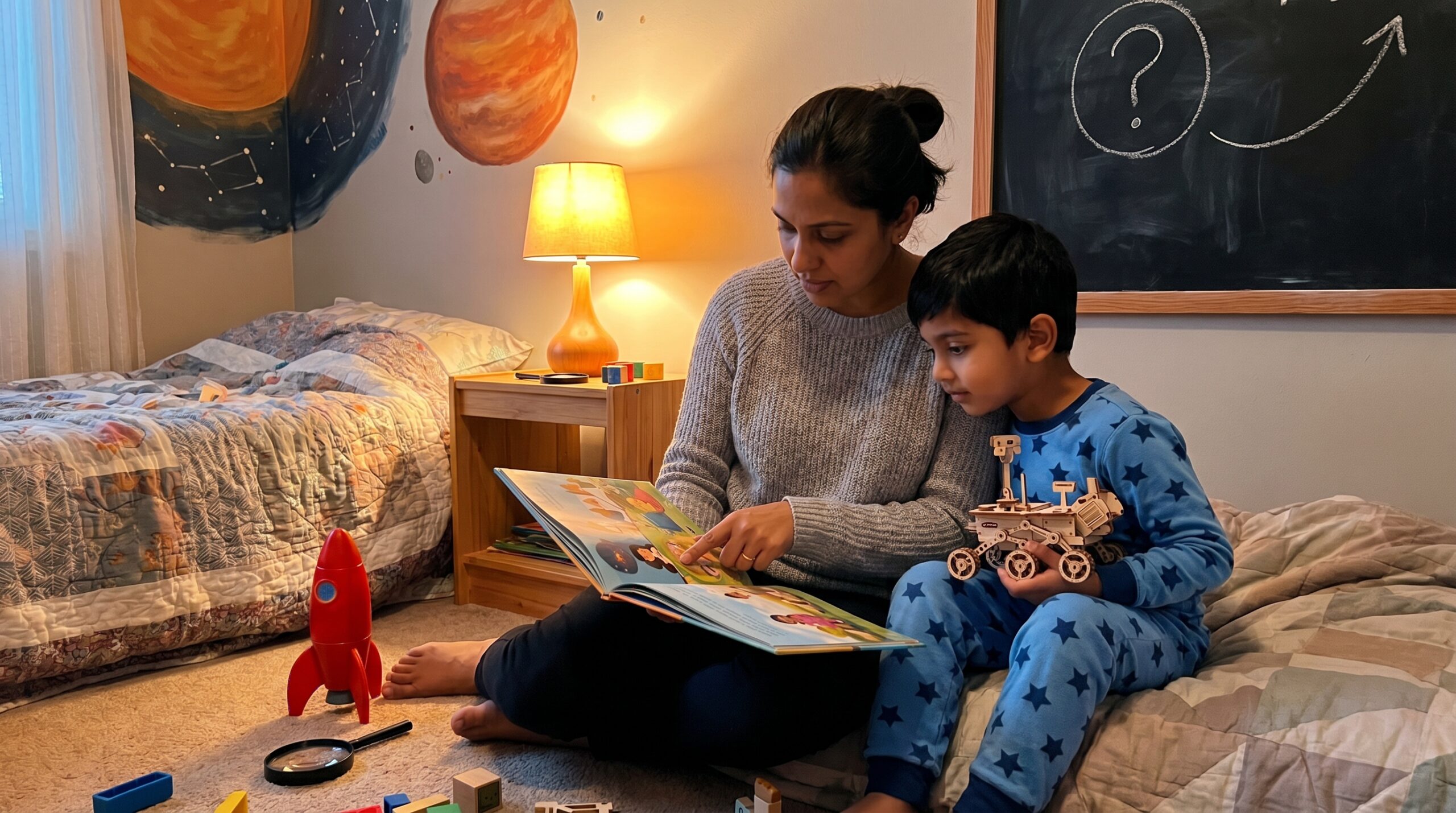
Stephen Hawking for kids begins with a curious question. On a clear evening a child might ask, why does the sky look different near the moon? That single why was Stephen William Hawking’s fuel. He was born on 8 January 1942. He grew into one of the most imaginative minds in cosmology.
Stephen Hawking for kids: Early life and path
Hawking studied at Oxford and then at Cambridge. He completed his doctorate and later became Lucasian Professor of Mathematics at Cambridge. That post had once been linked with Isaac Newton, which makes it extra notable. In 1974, at the remarkably young age of 32, Hawking was elected a Fellow of the Royal Society, one of the youngest scientists to receive this honor, highlighting his early achievements in science.
In his early 20s, doctors diagnosed him with amyotrophic lateral sclerosis (ALS) at the age of 21 in 1963. They expected only a few years of life. Instead, he lived for 55 more years, passing away in 2018 at the age of 76. He used a wheelchair and a speech synthesizer. Yet he kept teaching, writing and puzzling over the cosmos.
Discoveries and big ideas
Hawking worked with Roger Penrose on proofs about singularities. These are places where gravity becomes extreme in Einstein’s theory. He also asked bold questions about the origin of the universe.
- He showed conditions where singularities can form in general relativity.
- He proposed that black holes can slowly lose energy through quantum effects.
- He linked gravity, quantum mechanics and heat in surprising ways.
Black holes and Hawking radiation
Think of a black hole as a very strong whirlpool for light. Hawking found that quantum effects let black holes leak tiny amounts of energy. Scientists call this Hawking radiation. This idea links big and small science in a delightful, mind-bending way. His paper Particle Creation by Black Holes has been cited 13,468 times, showcasing the significant impact of his research in the field of cosmology.
It changed how people think about black holes and the fate of information. Also, it deepened conversations across physics about gravity and quantum theory.
Books, public life and reaching kids
Hawking wrote to bring big ideas to many people. A Brief History of Time has sold over 25 million copies and has been translated into more than 40 languages, helping readers picture the universe. He also co-wrote children’s adventures with his daughter Lucy. These books mix imagination with scientific facts.
He appeared on television and in popular culture. As a result, more people grew curious about science. He used clear explanations and a joyful sense of wonder.
Family, resilience and character
Hawking married Jane Wilde in 1965 and they had three children. His life shows resilience and steady curiosity. He kept rigorous thinking and strong collaborations with other scientists.
He received many honors, including election to the Royal Society and the Presidential Medal of Freedom. He died on 14 March 2018. His legacy remains both scientific and human: curiosity, clarity and the stubborn habit of asking better questions. Recently, the Science Museum Group opened the new ‘Hawking Building’ for public tours on 11 October 2024, housing over 300,000 historic objects, including more than 1,000 items from Hawking’s office, showcasing the ongoing importance of his contributions to science.
Ways to notice Hawking with a child
Keep explanations simple and lively. For example, say a black hole traps light. Then add one short sentence that the image is simplified. This keeps wonder without confusion.
- Look at the moon tonight and ask one big why.
- Draw a waterfall and mark the edge as a place you cannot come back from.
- Read a short science story and ask, what would happen if…?
Read or listen to a story about Stephen Hawking now: Read or listen to a story about Stephen Hawking now: For 3-5 year olds, For 6-8 year olds, For 8-10 year olds, and For 10-12 year olds.
Also visit Storypie for more biographies and gentle science stories. Explore and listen as a family, and let curiosity lead.