
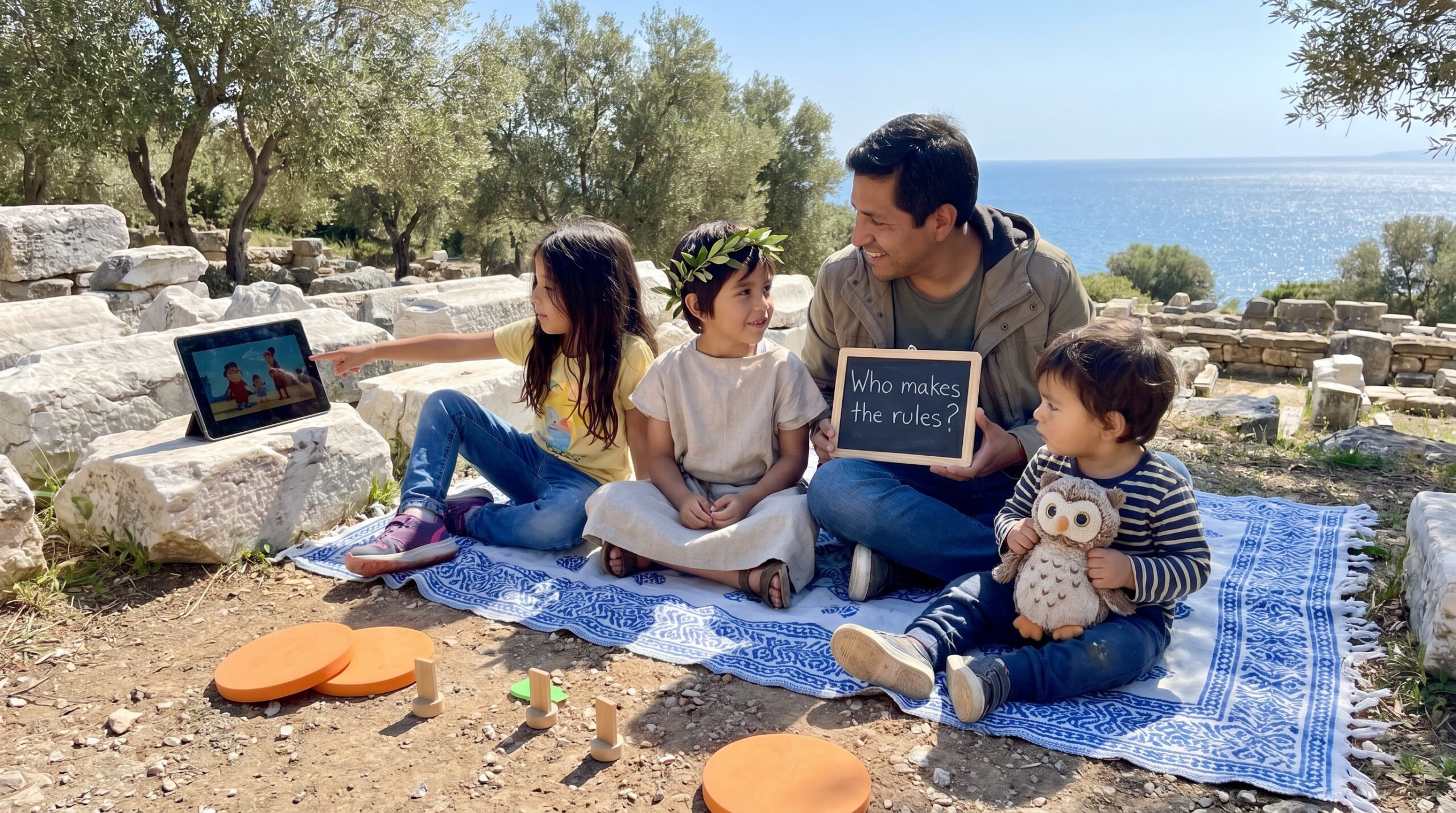
Ancient Greece for kids is a bright place to visit with stories and big ideas. Start with a chalk map, a pottery silhouette, a hero, and a question. Then you have an afternoon of wonder.
Ancient Greece for Kids: A Quick Timeline
Minoan Crete bloomed around 3000 to 1450 BCE. Next came Mycenaean Greece. Then the Greek Dark Ages followed. After that the Archaic and Classical periods rose, conventionally dated to about 480–323 BCE, marking the era between the Persian Wars and the death of Alexander the Great. Finally, the Hellenistic age spread Greek ideas across the Mediterranean. These dates show long change, not one single story.
Geography, City-States, and Daily Life
Geography shaped life in ancient Greece. Mountains and islands made many small city-states. These were called poleis. For example, Athens, Sparta, Corinth, and Thebes grew their own customs. The sea linked them. Trade helped ideas travel quickly. The population of Athens during the 5th century BCE is estimated to have been around 250,000 to 300,000 people, including citizens, metics (resident foreigners), and slaves.
Daily life included bread, olives, olive oil, wine, and fish. Clothes were simple linen or wool. Houses ranged from humble to large courtyard homes. Children played with toys and learned reading, music, and physical skills. Also, what a lively childhood that could be.
Athens, Sparta, and Gentle Contrasts
Athens loved theatre, debate, and art. Also, Athens practiced a form of direct democracy for free male citizens, established in the 5th century BCE, which allowed male citizens over the age of 18 to participate in the political process, excluding women, slaves, and non-citizens, as noted by the Stanford Encyclopedia of Philosophy. Meanwhile, Sparta trained as an army. Boys received tough schooling. Girls practiced public exercise and strength. Use this contrast as a fun role play: debating versus drilling, school versus camp.
Myth, Religion, and the Olympics
Religion and myth were part of daily life. Families told stories about Zeus, Athena, Apollo, and many others to explain storms, craft, and courage. Myths taught reasons and consequences. They fit wonderfully for ages four and up.
The Olympics began in 776 BCE at Olympia and were held every four years until 393 CE, making them a significant event that spanned over a millennium. Races, wrestling, javelin, and chariot games were serious business. Winners wore an olive wreath. Try a tiny paper wreath craft after a victory tale. It will make everyone grin. According to the International Olympic Committee, the games were deeply tied to religious festivals and showcased the athletic prowess of the competitors.
Philosophy, Science, and Lasting Words
Philosophers asked big questions. Thinkers such as Thales, Pythagoras, Socrates, Plato, and Aristotle wondered about numbers and right action. Scientists like Archimedes and Hippocrates explored machines and medicine. Over time their ideas grew into words we still use: democracy, philosophy, and geometry.
Art, Literature, and Hands-On Fun
Art and literature are lively windows into life. Homeric epics, dramatic plays, vase paintings, and Parthenon columns, which was constructed between 447 and 432 BCE during the height of the Athenian Empire as a temple dedicated to the goddess Athena, show great craft. For more on the Parthenon, check out the British Museum. Try a small column craft to explore Doric and Ionic shapes. Also, read a myth and then ask, ‘Who would you be and why?’ It sparks bright conversation.
Challenging Topics and How We Know
There were wars such as the Persian invasions and the Peloponnesian War. Also, hard topics like slavery existed. Present these gently and ask caring questions: how would you feel, and what would you change?
We learn from archaeology, ancient writers, inscriptions, and museum collections. For hands-on learning, visit a local museum or browse Storypie story collections.
Simple Activities to Try
- Make a paper olive wreath and tug a laugh from everyone.
- Craft a small column to spot Doric and Ionic shapes.
- Tell a short myth. Then ask, ‘Who would you be and why?’
Read or listen to a story about Ancient Greece now: For 3-5 year olds, For 3-5 year olds, For 6-8 year olds, For 8-10 year olds, and For 10-12 year olds.
If a child asks for the map and the vase again, you have sparked curiosity. That moment is the real delight of learning about Ancient Greece. Also, if you want the app, visit the Storypie get-app page for easy access.