
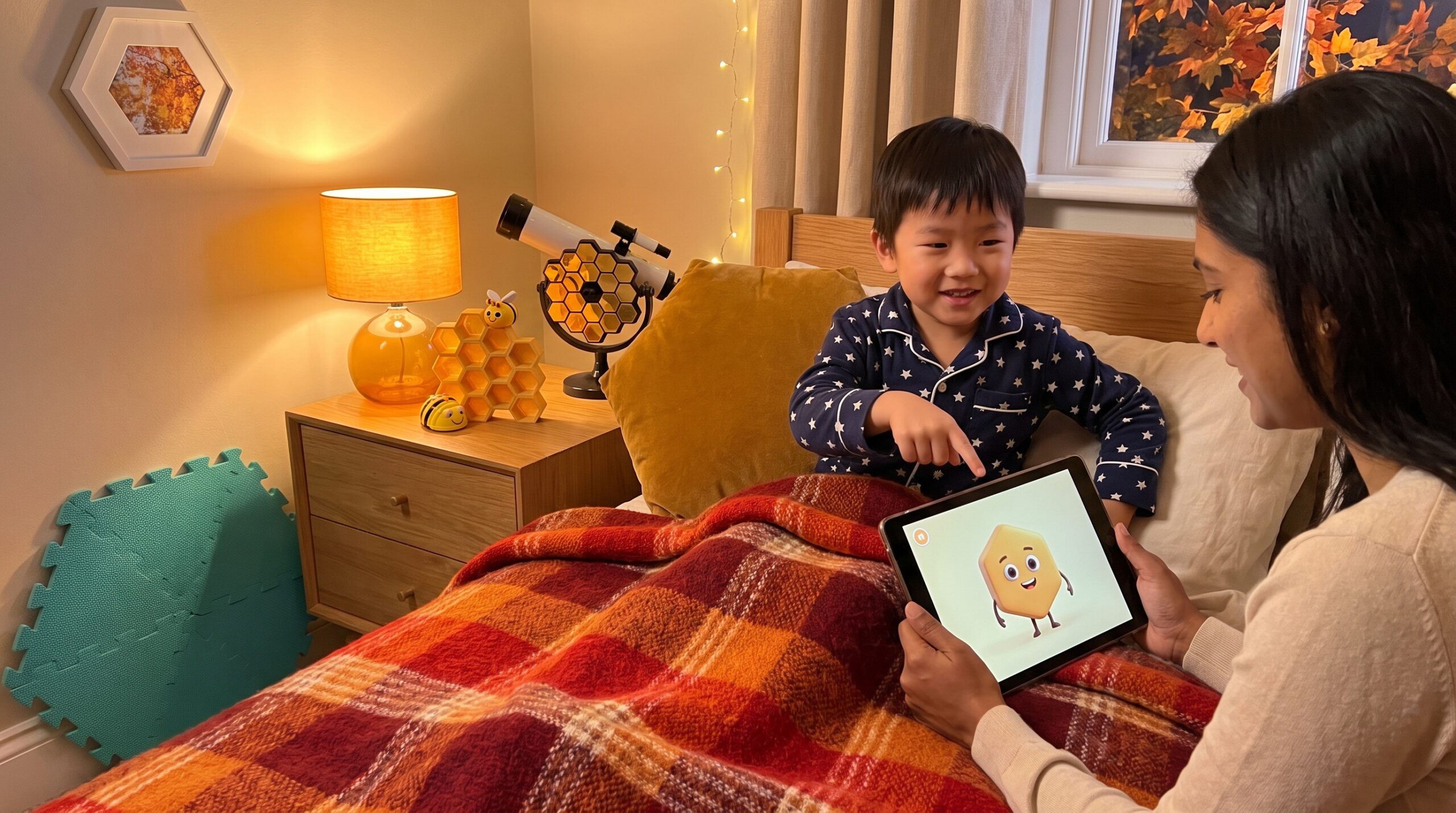
One crisp evening a very polite hexagon knocks at the window. The hexagon shape for kids introduces itself and tucks six soft sides together. Then it begins a sweet, tiny story about bees, snowflakes, and giant space mirrors. This playful voice fits a snug Storypie bedtime listen.
Hexagon shape for kids: What is a hexagon?
A hexagon is a six sided polygon. That means six sides and six angles. In any hexagon the interior angles add up to 720 degrees. In a regular hexagon all sides match and each angle is 120 degrees. Also, a regular hexagon splits into six equilateral triangles. So the distance from center to a corner equals the side length. Likewise, the apothem is about 0.866 times the side. Finally, the area comes to about 2.598 times the side squared.
Hexagons in nature and science
Hexagon shapes appear in joyful, surprising places. Bees build honeycombs that look like a perfect hexagonal quilt. For example, the Honeycomb Conjecture proved that hexagons cover equal area with the least perimeter. Thus bees save wax while keeping the most storage. Research shows that hexagonal patterns can be found in various natural formations, contributing to efficiency and space utilization in nature.
Snowflakes show sixfold symmetry because of how water molecules pack. Meanwhile basalt at the Giant’s Causeway forms tall hexagonal pillars when lava cools and cracks. Also, graphene arranges carbon atoms in a hexagonal lattice. Even Saturn sports a giant hexagon at its north pole, a feature that intrigues scientists and astronomers alike.
Why hexagons pack so well
Regular hexagons tessellate the plane without gaps. Their 120 degree corners let three meet at a point to make 360 degrees. Only triangles, squares, and hexagons tile a flat surface with regular shapes. Engineers use hexagons in tiles and honeycomb sandwich panels for aircraft, maximizing strength while minimizing weight. Telescope designers also use hexagonal mirror segments because hexagons pack into a near round disk with little wasted space, making them ideal for reflecting light in a compact design.
Family experiment: make and find hexagons
Try a tiny project after a Storypie listen. You will need paper, scissors, and a ruler or a cup. Optionally add straws or tape.
- Draw a circle and mark six evenly spaced points. Connect the dots to make a regular hexagon.
- Cut out several hexagons and tile them on a table like a honeycomb.
- Compare a hexagon tile with square and triangle tiles of the same area. Which shape uses more edge to hold the same space?
Tip: After listening, ask your child to find five hexagons in the room. It is a fun little scavenger hunt.
Read or listen to a story about Hexagon now: For 3-5 year olds, For 3-5 year olds, For 6-8 year olds, For 8-10 year olds, and For 10-12 year olds.
Final thought
Hexagons are simple and surprising. They help bees in nests and help engineers in space. For instance, in 2025, Hexagon reported operating net sales of €1,429.2 million in Q4, showcasing their significant presence in the market and their role in various engineering fields. For more short, friendly stories and playful STEM prompts at bedtime, explore Storypie.
Explore Storypie for more gentle STEM tales and kid-friendly concepts.