
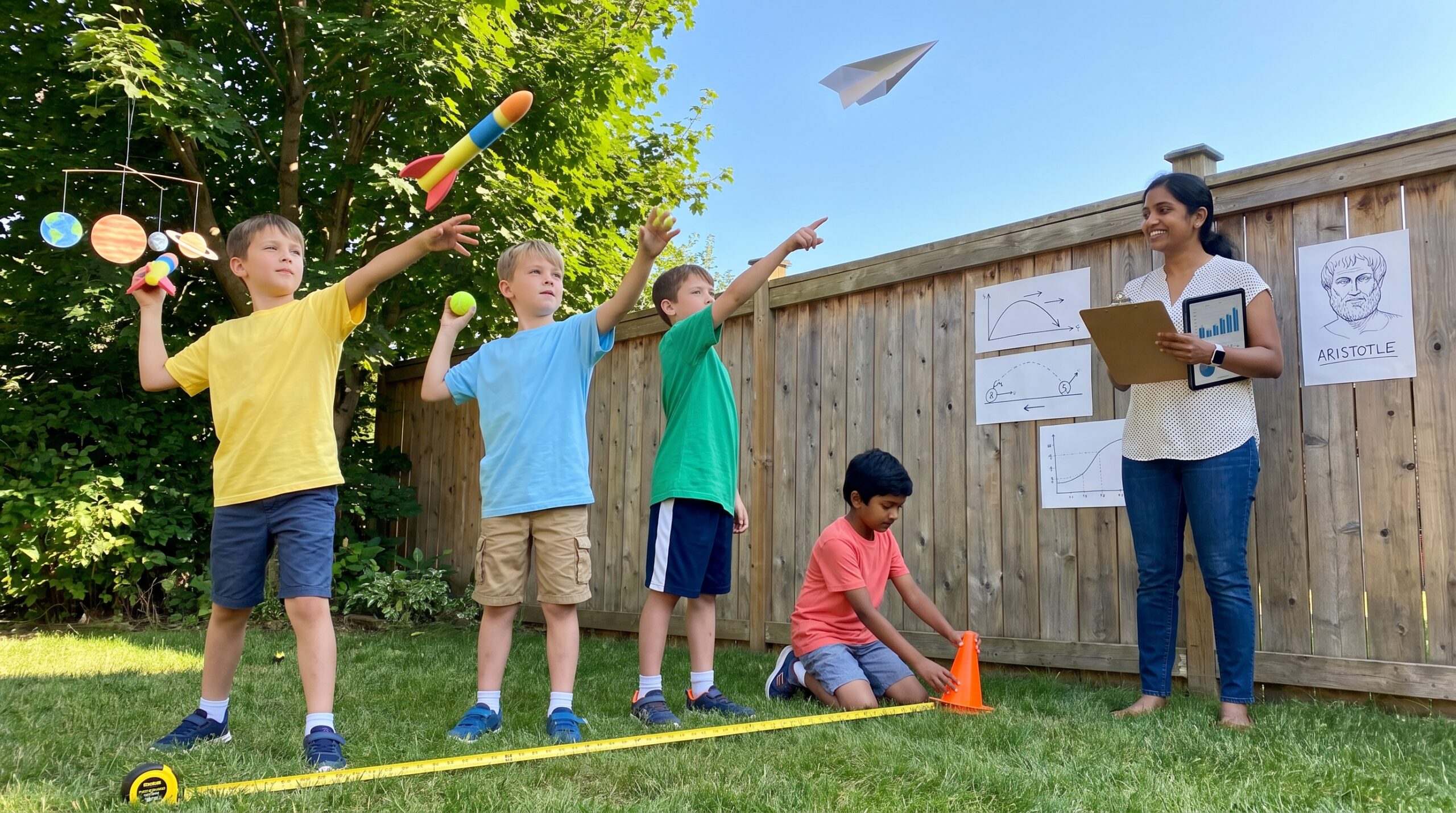
Start small: a soft ball, a sunlit yard, and two small hands. Projectile motion for kids begins with that simple scene.
Projectile Motion for Kids: Safe yard experiments
Try three soft balls of different weight and shape. Next, stand in the same spot for each throw. Use the same gentle push in every toss. Then mark where each ball lands. Notice which travels farthest. Ask children which felt fastest. Also ask which seemed to float more. Keep it tactile and playful.
Safety first. Pick a clear area away from windows and streets. Use soft balls and simple chants like “Ready, set, whoosh.” Small rituals help focus curious minds.
How to see the two motions
Look carefully. The path looks like a single arc. Yet two motions happen at once. Horizontally, the ball moves nearly with steady speed. Vertically, gravity pulls the ball downward, with an acceleration of –9.80 m/s² for the vertical component, while horizontal acceleration is zero. This fundamental understanding of the forces acting on a projectile is essential for grasping the concept of motion (OpenStax). For rough backyard math, use g = 10 m/s². In the ideal case the path is a parabola.
Equations are simple and tidy. Use x(t) = x0 + v0x t. Use y(t) = y0 + v0y t – 1/2 g t². Also remember v0x = v0 cosθ and v0y = v0 sinθ. For example, a ball launched at 10 m/s at 45 degrees lands about 10 meters away when g ≈ 10 m/s². Research shows that the maximum range of a projectile on level ground is achieved when launched at a 45-degree angle (IEEE Technology Navigator). That quick number often sparks a real wow moment.
Simple formulas and playful checks
Measure hang time with a phone stopwatch. Use T ≈ 2 v0 sinθ / g to estimate time in the air. Use H ≈ v0² sin²θ / (2 g) to guess maximum height. Let older kids try the math. Let younger kids hold the tape and count aloud.
- Time two throws to compare hang time.
- Launch from a chair to change the starting height.
- Try slow motion video for a closer look.
Keep the math light and playful. Also keep questions open. The point is curiosity, not perfect answers.
Real life adds surprise
Leaves and paper rarely follow neat parabolas. Air resistance, shape, wind, and spin change the path. For example, a spinning soccer ball curves from the Magnus effect. A leaf flutters and slows in a lovely, unpredictable way.
For very high speed or very tall launches, a projectile can fall around Earth instead of into it. This idea connects a backyard toss to big space stories.
A quick history note
Long ago, Galileo used inclined planes and careful observation to show curved paths. Later, Newton placed the same rules into universal motion. Thus your yard toss joins a long, lively conversation that built modern science.
Read or listen to a story about Projectile Motion now: Read or listen to a story about Projectile Motion now: For 3-5 year olds, For 6-8 year olds, For 8-10 year olds, and For 10-12 year olds.
Try small extensions
Next steps are simple. Time two throws to compare hang times. Watch how spin bends the path. Have kids sketch the arc on paper. These tiny experiments make STEM feel like a gentle game. For instance, a projectile launched with an initial speed of 70.0 m/s at 75.0° above the horizontal has a maximum height and flight duration that can be calculated using the independence of horizontal and vertical motion (OpenStax).
Finally, for a next step, try a Storypie story or activity to extend the play. Visit Storypie for friendly stories and activities to keep curiosity alive.
Toss, watch, and learn. That is delightfully simple science.