Westward Expansion for kids is a story I return to again and again. I tell small, human scenes to make big history feel close. For example, a single wagon wheel can open a whole world.
Meet people who mattered in Westward Expansion for kids
This crisp October morning on Storypie we meet Sacagawea. She guided Lewis and Clark, carried her son, and helped protect journals. Her courage bridged cultures. Also, Meriwether Lewis and William Clark mapped the new lands. Furthermore, Thomas Jefferson made the Louisiana Purchase, where in 1803 the United States purchased approximately 828,800 square miles of land from France for $15 million, effectively doubling the nation’s size, according to the Library of Congress. In addition, Brigham Young led Mormon migrants west. Chinese laborers helped build the Transcontinental Railroad, which was completed on May 10, 1869, and significantly facilitated westward settlement, as noted by the U.S. House of Representatives.
Key moments to know
- 1803 Louisiana Purchase roughly doubled U.S. land.
- 1804 to 1806 Lewis and Clark explored western lands.
- 1840s and 1850s thousands traveled the Oregon Trail, with nearly 500,000 emigrants journeying over the Oregon, California, and Mormon Trails from 1841 to 1869—a migration described as ‘one of the largest peacetime mass migrations in human history,’ according to the U.S. National Park Service.
- 1848 to 1849 California Gold Rush brought a sudden crowd.
- 1862 Homestead Act offered 160 acres to settlers who improved land; this act granted land to settlers who paid a small fee and agreed to work the land for five years, as outlined by the U.S. House of Representatives.
- 1869 Transcontinental Railroad cut months to days.
Daily life, dangers, and change
Families rode in covered wagons or walked beside them. Women cooked, mended, and cared for children. Children learned by a campfire. Dangers included cholera, river crossings, storms, and accidents. Towns sprang up near mines and railroad stops. Some towns lasted. Others vanished. Also, the environment changed fast. Bison numbers fell from tens of millions to near extinction. Farming and ranching reshaped grasslands and rivers. These changes had deep consequences for Plains tribes and wildlife.
People affected
Countless Native nations were pushed from their homelands. They faced broken treaties, disease, and violence. This part of the story is painful. We tell it clearly and gently. For parents and teachers, this opens thoughtful conversations.
Try a quick map activity
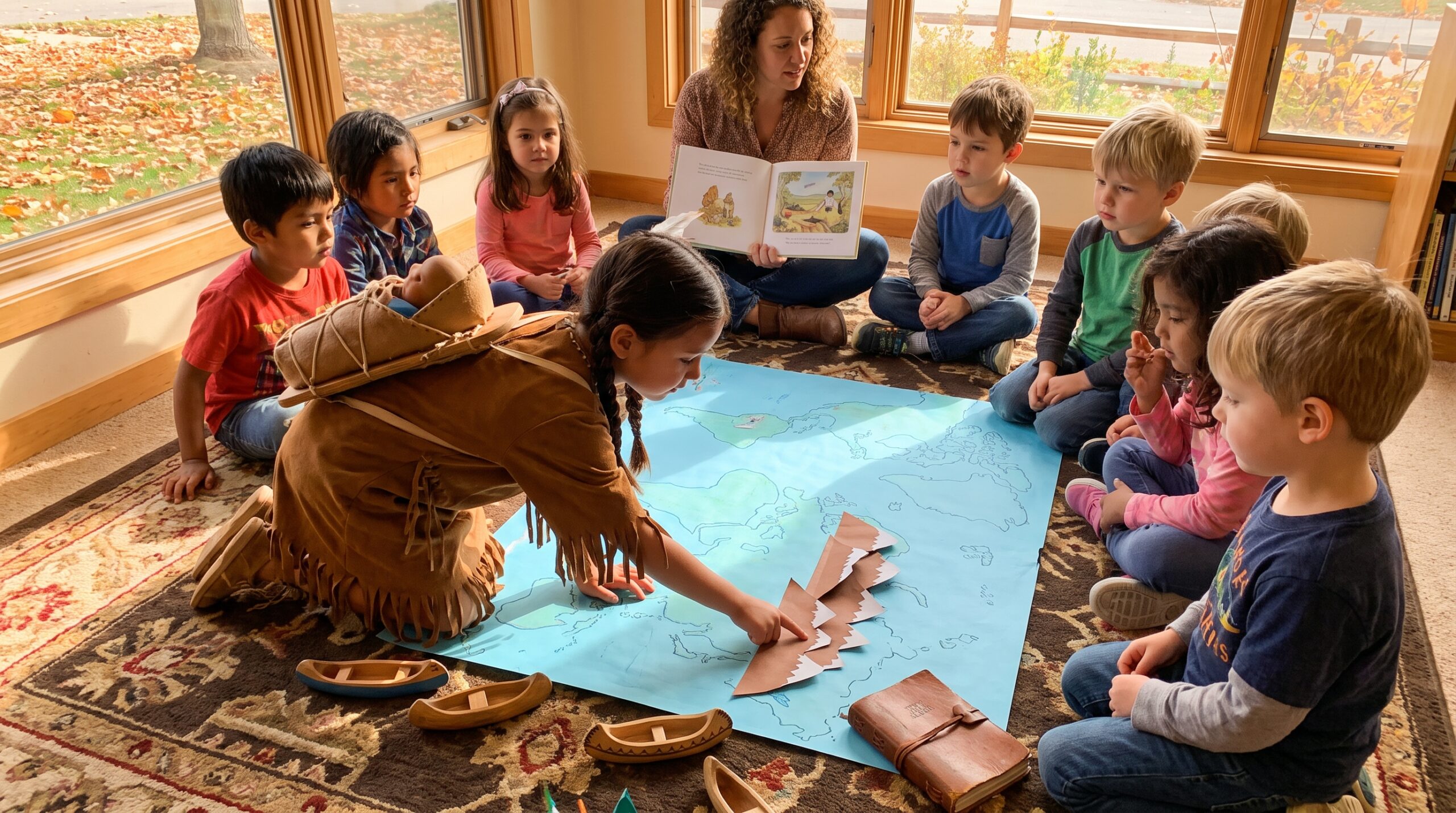
I like hands on history. Try this five minute activity with your child. First, find the Mississippi River on a map. Next, trace the Oregon Trail. Then, mark the mountains and the Pacific coast. Finally, ask one curious question about families who already lived there. This simple step boosts spatial thinking and sparks conversation.
Read or listen to a story about Westward Expansion now: For 3-5 year olds, For 6-8 year olds, For 8-10 year olds, and For 10-12 year olds.
Also, explore more family stories on Storypie: Storypie. For the app, visit Get the Storypie app. These links help you find age-appropriate Storypie episodes and activities.
Quick glossary
- Manifest Destiny: the belief that the nation should expand.
- Homestead: land given to settlers who farmed it.
- Trail: routes families followed west.
- Reservation: land set aside for Native nations.
I tried this approach with my niece last week. We read, pointed at the map, and she asked a brilliant question about families who already lived there. Conversation landed. That is the goal. Try it tonight: five minutes, one map, and one curious question. Storytime wins again.