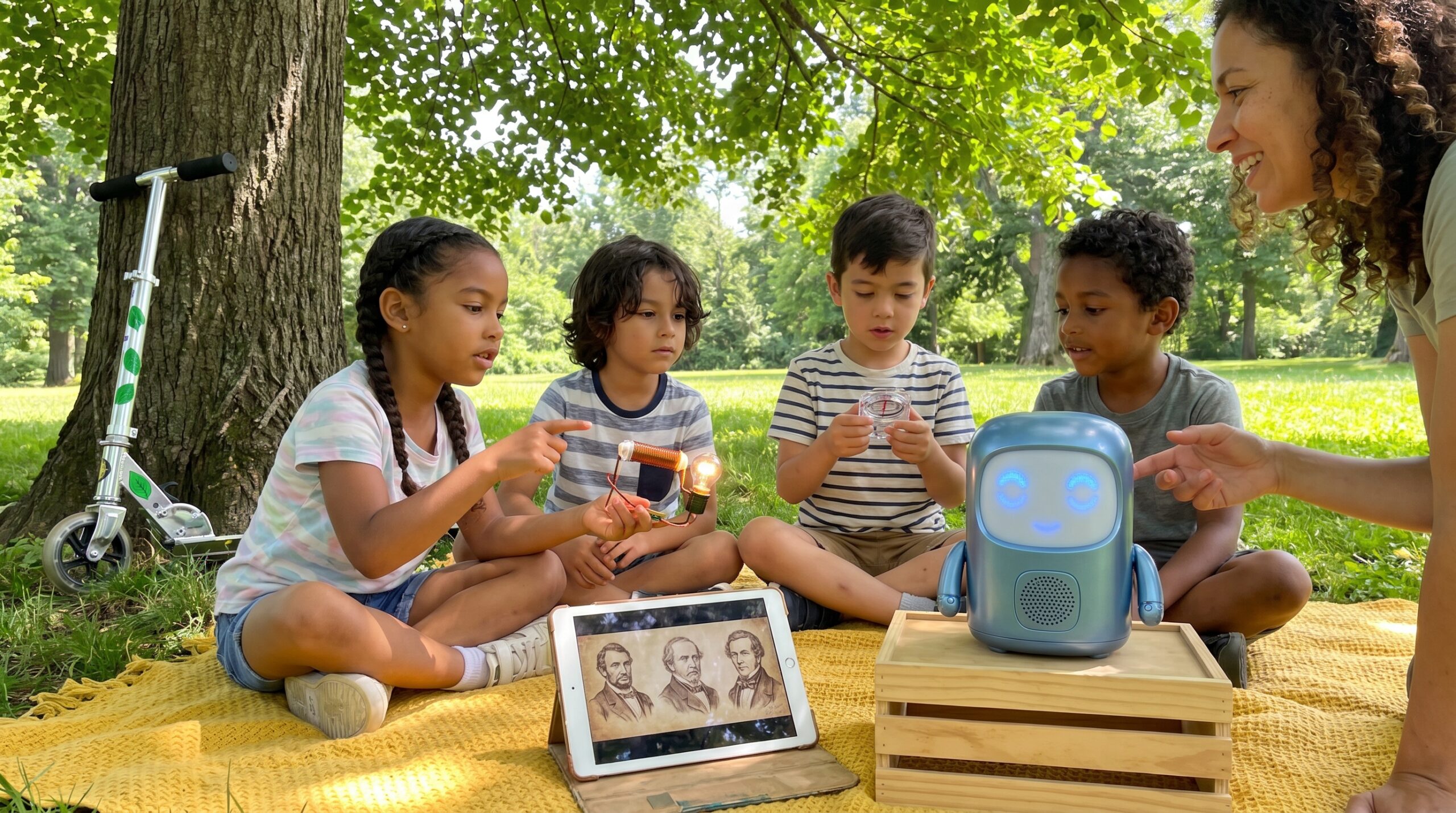
This sunny June afternoon at Storypie I shared a tiny moment that showed what an electric motor for kids can feel like. The first spin made my child’s eyes go huge, and I still tell that story at bedtime.
How an electric motor for kids works
An electric motor for kids turns electrical energy into motion. First, electricity runs through coils of wire. Then the coils make a magnetic field. Next, that field meets a magnet. They push and push and push in a circle. Finally, the rotor spins and makes toys or fans move. Tiny physics. Big fun. In fact, in 2023, electric motor systems accounted for 53% of global electricity consumption, showcasing their importance in transforming energy into motion.
Main parts to point at
- Stator: the stationary part that makes the magnetic field.
- Rotor: the part that turns.
- Windings: the coiled wires that carry current.
- Magnets: permanent magnets or electromagnets.
- Commutator and brushes: older designs that switch current.
- Electronic controller: used in many modern motors instead.
Motor types you will see
Kids will meet several motor types at home and in play. For example, brushed DC motors power simple toys. Brushless DC motors run drones and computer fans. AC induction motors drive washing machines and pumps. Universal motors power blenders and vacuums. Stepper and servo motors appear in robots and printers. Interestingly, the industrial electric motors segment held 55% of the global market in 2023, driven by automation in manufacturing sectors.
Everyday scavenger hunt and a tiny demo
Try a scavenger hunt tonight. Ask your child to find three electric things at home. Try a ceiling fan, a toothbrush, and a toy car. Also, notice how tiny motors use a fraction of a watt. Meanwhile, kitchen appliances use tens to thousands of watts. Finally, car motors can be tens to hundreds of kilowatts. In 2023, electric vehicle (EV) motor production reached 15.2 million units globally, reflecting the rapid growth in the EV market.
Try a safe, simple homopolar motor together. You need one AA battery, a strong magnet, and a short piece of copper wire. Place the magnet on the battery’s negative end. Then balance the wire so it touches the battery and the magnet. Next, watch it spin. Do this with an adult watching. It feels like tiny, noisy magic.
Safety and why it matters
Safety first. Small batteries and magnets are choking hazards. Never short a battery. Strong magnets can pinch fingers. Always supervise hands-on work. Also remember that motors are efficient. When electricity is clean, motors cut local pollution. In electric cars, motors can even act as generators to recover energy. The U.S. electric motors market revenue reached USD 28.7 billion in 2023, boosted by the ramp-up in EV production by companies like Tesla and General Motors, showing their economic importance.
Conversation prompts and read-alouds
Conversation starters can turn a moment into learning. Ask: What would stop working without motors? How is a toy car like a real electric car? What did Ørsted and Faraday discover together? These questions spark curiosity and gentle wonder.
Read or listen to a story about Electric Motor now: For 3-5 year olds, For 6-8 year olds, For 8-10 year olds, and For 10-12 year olds. Also see the full story page: Read or listen to a story about Electric Motor now.
For more playful science, consider the Storypie app. It offers stories and activities that spark curiosity. Try the app when you want another tiny, joyful experiment.
Try the scavenger hunt tonight. Giggle at the tiny whirl. Celebrate the small win. Then, maybe, try another experiment tomorrow.