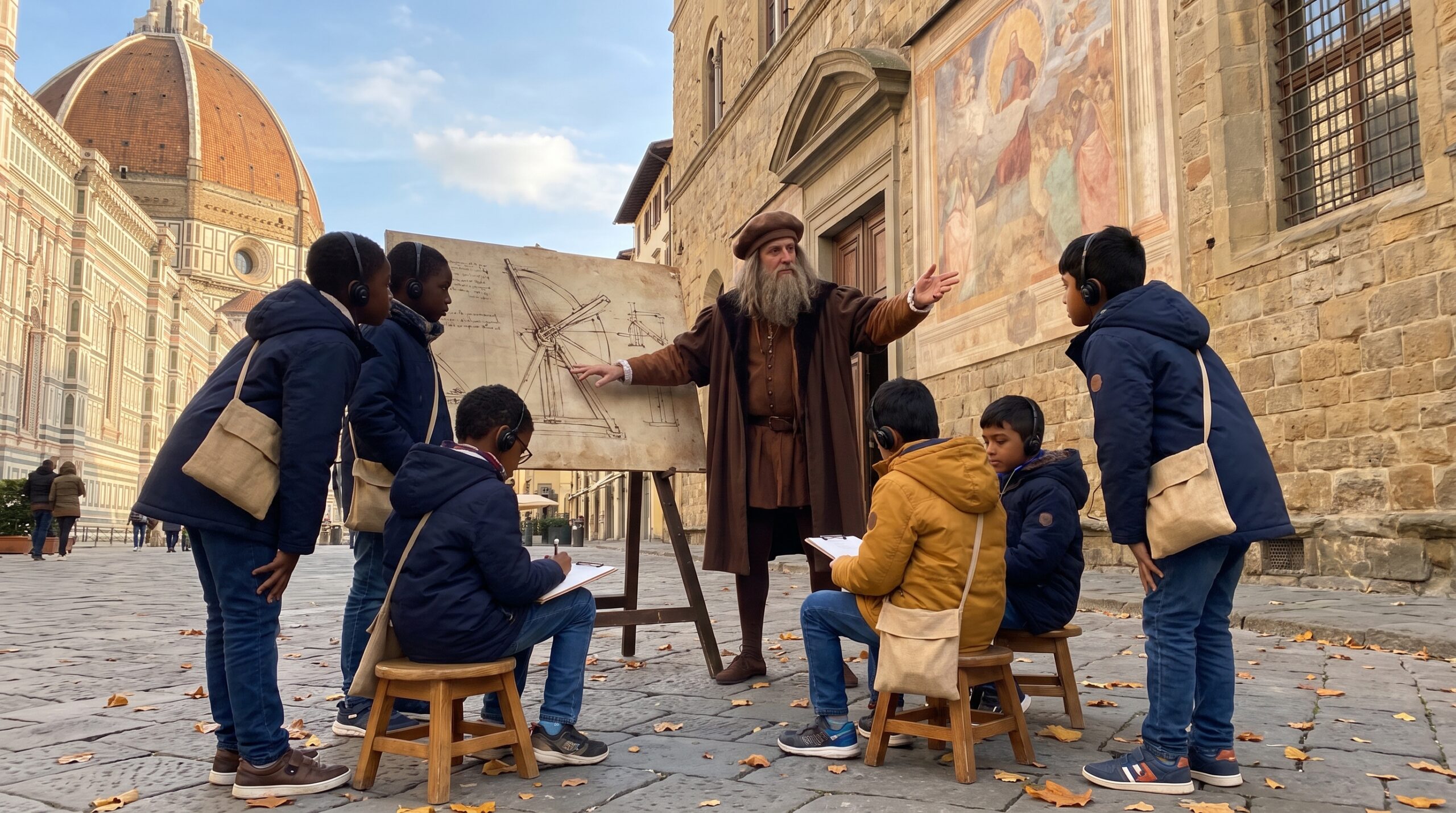
The Renaissance for kids comes alive in Storypie’s short journeys. Curious children listen as Leonardo leads them through Florence. Then they sketch one small thing they noticed. Tip: after listening, try a two minute sketch and a quiet cheer. Get the app at https://mystorypie.com/get-app
The Renaissance for kids: a quick overview
The Renaissance, meaning “rebirth,” was a period of European cultural, artistic, political, and economic revival following the Middle Ages, generally described as taking place from the 14th century to the 17th century. It began in 14th century Italy, with Florence leading the way. Wealth, trade, and families like the Medici paid artists and thinkers. First, scholars read old Greek and Roman books. Then writers used local languages so more people could read. Gutenberg’s printing press helped books spread fast.
Art that looks alive
Art changed in clear ways. Painters learned linear perspective to show depth. They used light and shadow, called chiaroscuro. Also they softened edges with sfumato. Artists studied anatomy to make faces and bodies move. Leonardo, Michelangelo, Raphael, and Botticelli made images that felt alive and real. For example, look for the Mona Lisa, Michelangelo’s David, and the Sistine Chapel ceiling.
Science, measurement, and close looking
People started to measure and test what they saw. Leonardo drew plants, machines, and bones. Then later scientists suggested the planets circle the sun. Galileo used telescopes and careful notes. The new method was simple: look, test, and write.
Architecture, workshops, and daily life
Brunelleschi built the great dome of Florence Cathedral. He used classical forms and clever engineering. Shops and guilds taught crafts. Markets filled town squares. Music grew richer with layered voices. Schools and courts became lively places for learning and debate. In fact, by the late 1330s, approximately 8,000 to 10,000 boys and girls were learning to read in Florence, demonstrating a growing commitment to education that was crucial for the cultural revival of the time, with male literacy reaching about 80 percent by 1427, according to Oxford Academic.
How patrons changed everything
Wealthy patrons paid for workshops and libraries. The Medici family turned Florence into a place of creative risk and learning. Also, universities and courts served as labs of ideas. The printing press put books in more hands and brightened many eyes. Between the years 1000 and 1820, GDP per head in Western Europe increased threefold, while GDP per head for the rest of the world grew only by 33 percent, illustrating the economic growth that characterized the Renaissance, as detailed by Cambridge University Press.
Small rituals to spark curiosity
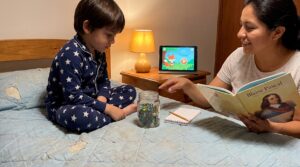
Parents and teachers can build short, joyful rituals. Sit together and look closely at a page. Ask one open question like What do you notice about light? Then invite a quick sketch. Celebrate small discoveries with a tiny sticker or a quiet cheer. These simple moves help children see the world like tiny scientists and joyful artists.
Read or listen to a story about The Renaissance now: For 3-5 year olds, For 3-5 year olds, For 6-8 year olds, For 8-10 year olds, and For 10-12 year olds.
For more short journeys and stories, visit Storypie at https://mystorypie.com.