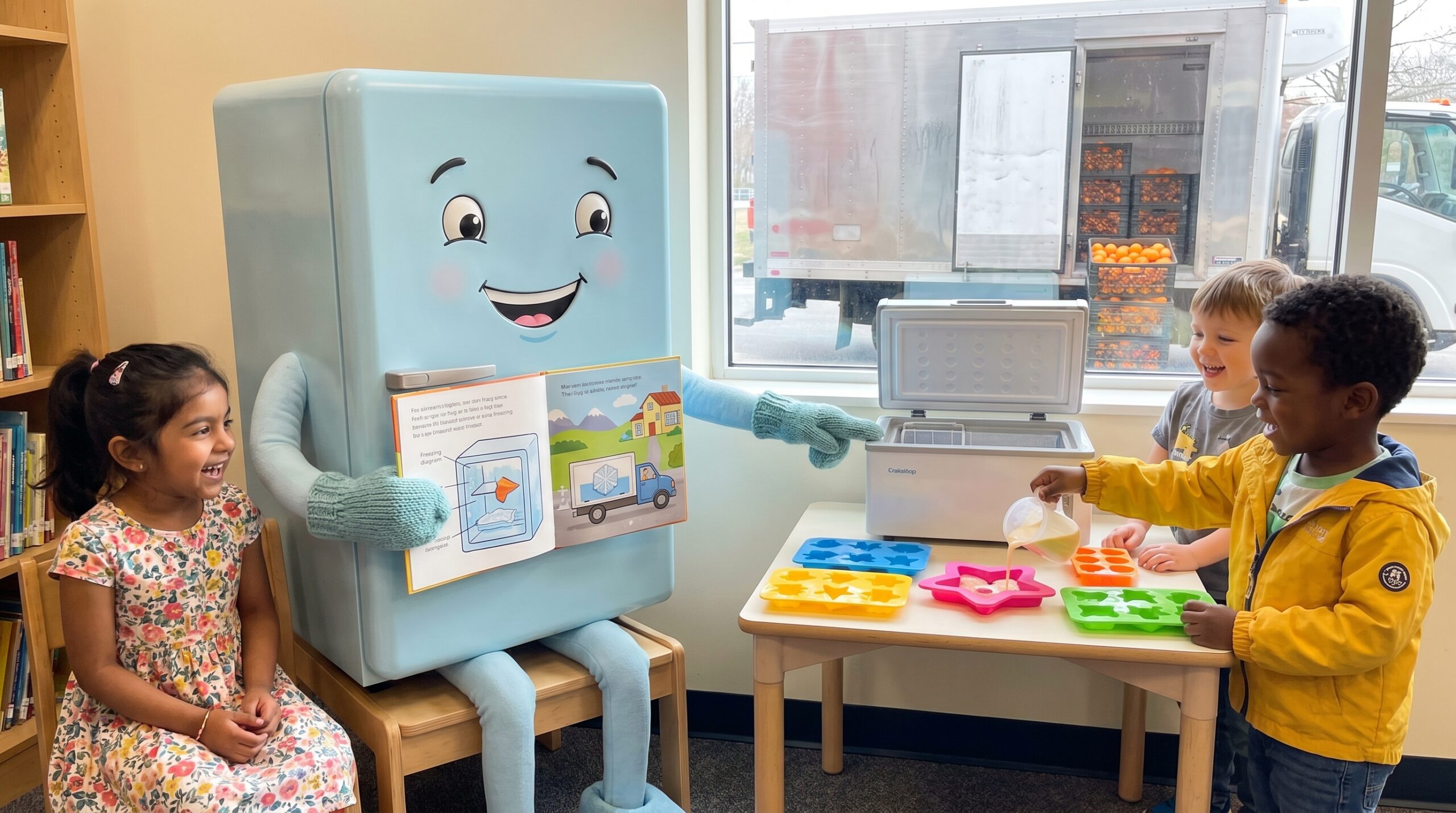
This home freezer guide explains how cold keeps food fresh. It shows simple rules families can use. Also, it shares kid-friendly ideas and safety reminders.
Home Freezer Guide: Temperatures and Storage
Keep freezers at 0°F (-18°C) or colder; ENERGY STAR’s guidance explicitly states “Keep the temperature at 0 degrees Fahrenheit.” This temperature slows bacteria and enzyme action. However, freezing does not sterilize food. Safe handling still matters.
Typical storage windows help planning. For quick reference, try this short list.
- Ground meat: 3 to 4 months
- Steaks and chops: 4 to 12 months
- Whole poultry: up to 12 months
- Poultry parts: about 9 months
- Lean fish: about 6 months; fatty fish: 2 to 3 months
- Cooked leftovers: 2 to 3 months
- Fruits and blanched vegetables: 8 to 12 months
- Ice cream best quality: about 2 to 4 months
Flash-freezing and Food Quality
Flash-freezing matters a lot. Quick freezing creates many small ice crystals. These crystals protect texture and flavor. Slow freezing makes larger crystals. Large crystals can rupture cells and change texture.
Clarence Birdseye pioneered quick-freezing in the 1920s. His work helped shape the modern frozen food world.
Types of Freezers and Energy Notes
You will find several freezer types. Each type has different benefits.
- Upright freezers: easy to organize.
- Chest freezers: often more energy efficient; ENERGY STAR certified chest freezers use about 215 kWh of electricity annually, costing approximately $30 per year to operate.
- Refrigerator-freezer combos: handy for small kitchens.
- Commercial reefers and walk-in units: built for large needs.
Keep gaskets clean and check the temperature regularly. Also, do not block vents. Clean condenser coils if you can. A fuller freezer uses energy more efficiently; certified upright freezers use about 395 kWh annually, costing around $60 per year.
Freezer Maintenance and Quality
Freezer burn results from dehydration and oxidation. It harms quality but is safe to eat. Wrap foods tightly and use freezer safe containers. Remove air and label packages. Portion before freezing to reduce waste.
Food Safety Tips and Thawing
Label and date everything. Then freeze in meal-sized portions. When you thaw, follow safe methods.
- Thaw in the refrigerator.
- Thaw under cold running water for a faster method.
- Or use the microwave and cook right away.
Do not thaw at room temperature. If food thaws in the fridge you can refreeze it safely, though quality may drop. For example, if frozen continuously at 0°F (−18°C), turkey products are ‘safe indefinitely,’ but recommended freezer storage times for best quality include: fresh whole turkey — 12 months; fresh turkey parts — 9 months; ground turkey/giblets — 3–4 months; cooked turkey — 4 months, according to the U.S. Department of Agriculture.
Kid-Friendly Ideas and Safety
Freezing can be playful and educational. Try juice molds or instant ice cream in a bag with ice and salt. For a tiny experiment, compare a quick freeze and a slow freeze to see a texture change.
Always supervise children. Never let kids climb into freezers. Consider a lock for chest models.
Read or listen to a story about Freezer now: For 3-5 year olds, For 6-8 year olds, For 8-10 year olds, and For 10-12 year olds.
Finally, freezing saves food and teaches science in small, fun ways. In fact, in 2023, 38% of consumers identified themselves as ‘heavy’ frozen food users, indicating a significant reliance on freezers for food storage. For more playful stories and activities, visit Storypie.