Seed dispersal for kids is a simple idea with big wonder. In short, seed dispersal means seeds move away from the parent plant to start new lives. Storypie loves these tiny moments of science you can share on a walk tonight.
Why seed dispersal matters
Moving seeds spreads genes and helps plants colonize fresh ground. Also, it reduces sibling competition and helps forests recover after fires or storms. This is crucial because seed dispersal underpins many important plant ecological and evolutionary processes such as gene flow, population dynamics, range expansion, and diversity, according to a 2023 review. So, seed travel keeps ecosystems lively and resilient.
Five easy ways seeds get around
Here are the main ways seeds travel. Each way is clever and sometimes surprising.
Wind (anemochory)
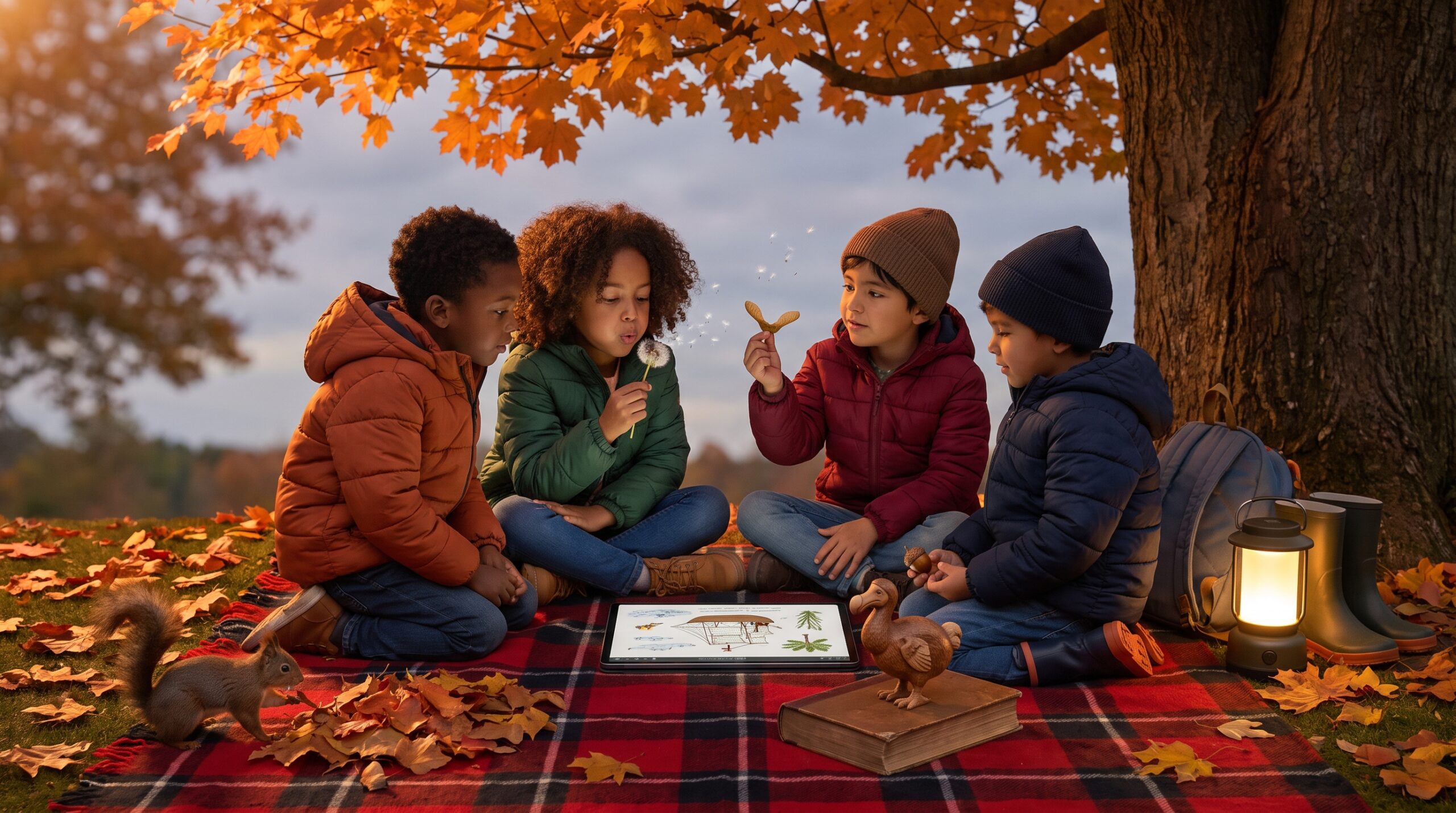
Wind carries light seeds like dandelion fluff. For example, maple samaras spin like tiny helicopters. Wind can move seeds a few meters or many kilometers.
Water (hydrochory)
Some seeds float. Coconuts and other buoyant seeds cross rivers and even seas. Therefore, water can be a powerful long-distance taxi.
Animals (zoochory)
Animals eat fruits and pass seeds in droppings. A substantial proportion of seed-bearing plants—approximately 75%—are reliant on various animal species (birds, mammals, ants, fish, reptiles) for seed dispersal, termed zoochory. In fact, many plants depend on animal helpers to move their seeds, as highlighted by research showing that among 1,901 plant species, 64% are dispersed by birds and 61% by mammals. This interconnectedness illustrates the critical dependence of many plants on animals for reproduction, according to Ecology and Evolution of Seed Dispersal.
Self-launching (autochory)
Certain plants eject seeds with a pop. Touch-me-not and some vines fling seeds outward. Next, those seeds land away from the parent plant.
Gravity (barochory)
Heavy nuts and acorns fall straight down. Then, animals like squirrels carry them farther and bury some for storage. Interestingly, animals play an even larger role in seed dispersal in certain ecosystems; for example, in tropical forest ecosystems, on average, 81% of trees rely on animal-mediated seed dispersal, based on extensive data from various vegetation plots as outlined in a study on tropical forest regrowth.
What seeds are built to do
Seeds come packed with traits for travel. Some have wings or a pappus. Others stay sticky or grow fleshy fruit to tempt animals. Also, some seeds offer ants a tasty elaiosome to carry them home.
Seeds may wait years in dormancy. Often, germination needs cues like light, temperature swings, abrasion, or passage through an animal gut. These cues help seeds sprout at the right time.
A very short history of seed movement
Long ago, farmers saved and planted seeds that stayed put and grew bigger. Over centuries, people changed plants to suit farms and gardens. Then, explorers and scientists like Charles Darwin studied how seeds survive seawater and animal guts. His curiosity helped us see dispersal as part of a living story.
Why animals matter and conservation notes
Many plants and animals depend on each other. The old Tambalacoque example about the dodo shows how losing a disperser can affect an island forest. Today, ecologists sometimes reintroduce ecological analogs to restore seed movement. In Europe, more than 350 bird and mammal species together disperse at least 17% (over 1,700 plant species) of the total European flora, illustrating the significance of animal contributions to ecosystems, as noted in Seed Dispersal in Europe.
Seed banks act like libraries for seeds. They save plant diversity for the future. Also, human actions affect seed movement both ways. We move seeds with trade and travel, which spreads invasives. But we also plant native shrubs and restore habitats.
Small family actions that help
- Plant fruiting native shrubs to feed local wildlife.
- Avoid brushing against plants that spread hitchhiking seeds.
- Support local conservation efforts and native restorations.
A simple 10-minute walk to try
Try this tiny experiment with your child. First, find these seeds on your walk: a helicopter seed (maple), a fluff seed (dandelion), a hooked seed or burr, a berry or fleshy fruit, and a heavy nut or acorn. Then, ask your child where each seed might land and who might move it next.
Do not taste unknown seeds. Also, only take a few samples with permission. Finally, wash hands after handling.
Read or listen to a story about Seed Dispersal now: Read or listen to a story about Seed Dispersal now: For 3-5 year olds, For 6-8 year olds, For 8-10 year olds, and For 10-12 year olds.
Celebrate the small wonders
Take that 10-minute walk tonight. Make a tiny map of where seeds might land. Then, celebrate the small wonders with a Storypie story or a chat. Happy exploring!