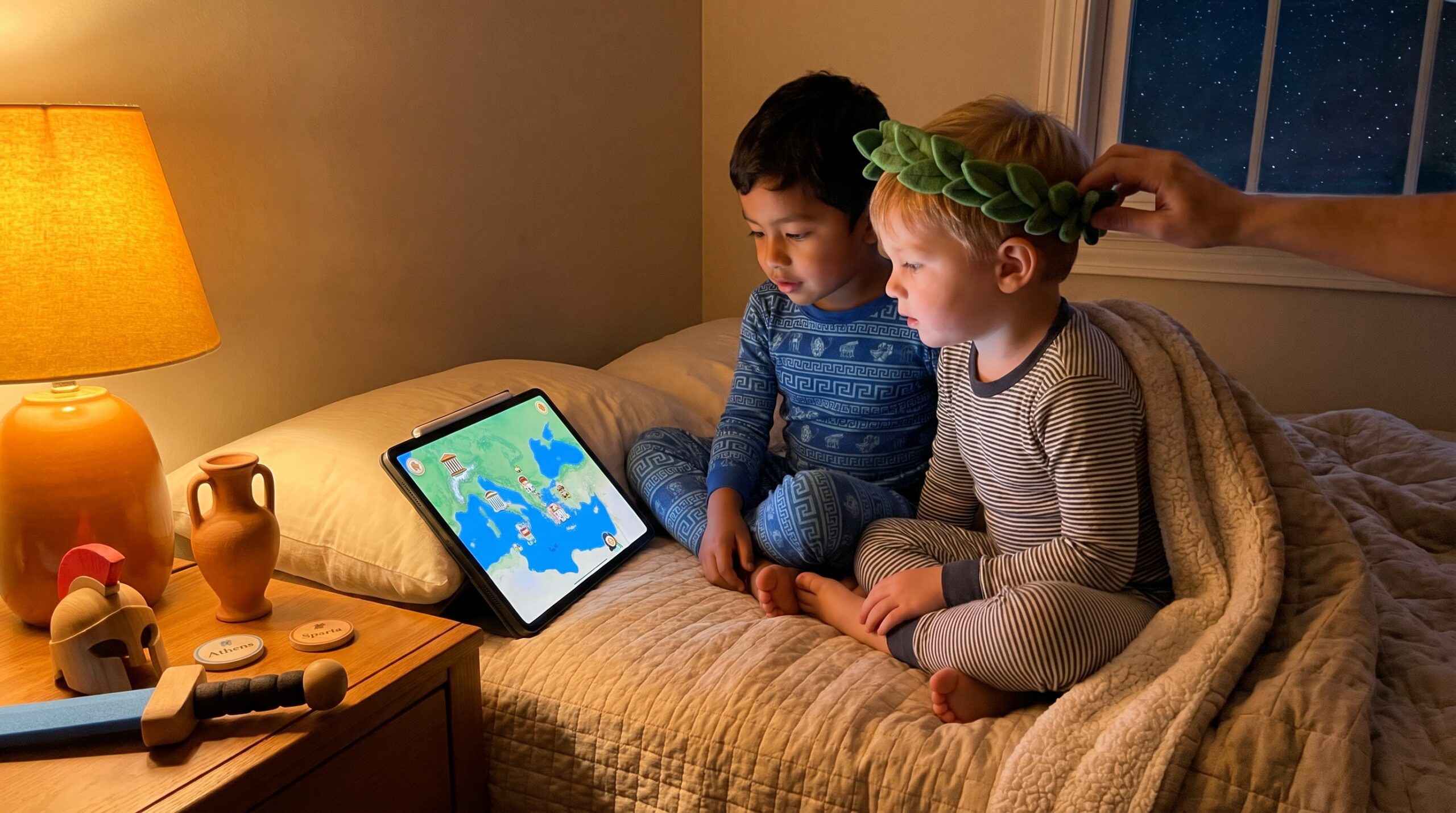
Ancient Greeks for kids is a small, warm introduction to a big story. They lived around the Aegean Sea for many centuries. First, their history runs from about 1600 BCE to 31 BCE. Also, they lived on rocky islands, in peninsulas, and in distant colonies.
Ancient Greeks for kids: Timeline and places
For example, their long past divides into several eras. These eras include Mycenaean, Dark Ages, Archaic, Classical, and Hellenistic. Meanwhile, colonies spread Greek ideas to Italy, Sicily, Asia Minor, North Africa, and the Black Sea. The landscape shaped their lives. Hills, small farms, and harbors mattered a great deal. In about 400 BC, historical sources record approximately 850 Greek city-states (poleis) in existence, and during the Classical period, at least 1,000 poleis existed simultaneously, showcasing the political diversity of Ancient Greece.
City-states, or polis, and everyday life
The basic political unit was the polis, a city-state. Each polis mixed a town, nearby farms, and a shared identity. Athens, Sparta, Corinth, Thebes, and Syracuse all followed their own paths. Around 500 BC, the city-state of Athens had an estimated total population of about 200,000, but only approximately 35,000 were full citizens, highlighting the social structure of one of the most significant city-states in Ancient Greece.
Some city-states had kings or oligarchs. Others chose tyrants for short periods. Also, Athens created an early form of democracy. There, free adult men voted in assemblies. The Delian League, a confederation of Greek city-states under the leadership of Athens, was established in the 5th century B.C. to continue the fight against Persian forces, illustrating the political alliances that shaped Ancient Greek society during a critical period.
Families ate bread, olives, cheese, fruit, and fish. People wore simple tunics called chitons. Houses in the country tended to be plain. Town homes stayed compact and neat. Children played games, learned songs, or helped at work.
Education and roles
Education varied by polis. Athenian boys studied reading, music, and debate. In contrast, Spartan boys trained in running, hunting, and discipline. Girls usually learned household skills, though Spartan girls exercised and owned property. A maximum literacy level of around 20–30% may have been reached in Hellenistic cities, indicating that mass literacy was never achieved in the ancient world.
Beliefs, myths, and public life
Religion ran through daily life. Greeks honored many gods who lived on Mount Olympus. They worshiped Zeus, Hera, Athena, Apollo, Artemis, and Poseidon. Temples, sacrifices, and festivals marked the year. Oracles at Delphi helped shape choices. Myths explained the world and gave thrilling tales.
Art, stories, games, and ideas
They loved stories and creative arts. Homer sang the Iliad and the Odyssey. Theaters staged tragedies and comedies by Aeschylus, Sophocles, Euripides, and Aristophanes. Meanwhile, sculptors and vase painters showed gods, athletes, and everyday scenes.
Thinkers like Pythagoras, Hippocrates, Socrates, Plato, Aristotle, and Archimedes pushed ideas in math, medicine, and thought. Buildings used three column styles: Doric, Ionic, and Corinthian. The Parthenon in Athens still stands as a clear example. Among renowned mature men (ages 15+) in ancient Greece between 450 BC and post 100 BC, mean life expectancy was estimated at 68–71.5 years, while the average age of death based on adult skeletal remains in Classical Greece was 37.7–42.6 years, providing a nuanced understanding of health and longevity in Ancient Greece.
Sport mattered too. The first recorded Olympic Games began in 776 BCE at Olympia. They honored Zeus and included running, wrestling, and chariot racing. Also, war shaped Greek history. Greeks fought Persia, then each other in the Peloponnesian War. Later, Alexander of Macedon spread Greek culture across a wide world.
Work, trade, and legacy
Many families farmed olives and grapes. They made pottery and sailed to trade. Colonies helped move goods and ideas. The Greek language, democratic experiments, art, and the Olympics left a large legacy. Today, these things shape words, schools, and imagination.
Small wonders: simple activities and pronunciation
Try tiny activities to bring the past close. Taste olives or yogurt. Read a vase picture together. Time a short running race in the backyard. These small moments make history bright and friendly.
Pronunciation helps too. Try these: Athens is ATH-ens, Sparta is SPAHR-tuh, Zeus is ZOOS, and Homer is HOH-mer. Little rituals add a spoonful of wonder.
Read or listen to a story about Ancient Greeks now: For 3-5 year olds, For 3-5 year olds, For 6-8 year olds, For 8-10 year olds, and For 10-12 year olds.
Explore these tiny wonders with Storypie for calm bedtime curiosity. Save this guide and return often. Enjoy learning.