This Walter Houser Brattain biography introduces a curious, hands-on physicist who helped invent the transistor. He was born on February 10, 1902, in Amoy (now Xiamen), Fujian, China, and worked at Bell Telephone Laboratories, where he co-created the first working point-contact transistor on December 23, 1947.
Walter Houser Brattain biography: Why he matters
Walter Houser Brattain focused on careful experiments. He built and tested the tiny point-contact transistor while his teammates explored theory and design. Together, they proved that solid materials could amplify electrical signals. In fact, the point-contact transistor could amplify an input signal by up to 100 times, marking a significant milestone in electronics and showcasing Brattain’s crucial contribution to this invention, as noted by the Computer History Museum. That discovery made electronics smaller, faster, and more reliable.
The 1947 point-contact transistor
In the lab, Brattain used a small piece of semiconductor. He placed two closely spaced metal contacts on the germanium. When the setup came alive, the device amplified weak signals. It offered a compact alternative to fragile vacuum tubes. By 1952, the point-contact transistor was commercially employed in portable radios and hearing aids, illustrating its significance in consumer technology, as highlighted on Wikipedia.
How the transistor changed technology
Replacements for vacuum tubes led to dramatic changes. Radios and hearing aids grew smaller and consumed less power. Later, calculators, computers, and smartphones traced their roots to that family of devices. The transistor opened a path to modern microchips.
Brattain as a model for families
Brattain’s careful, patient style suits family learning. He shows that steady curiosity and teamwork matter. He did not work alone. Instead, patient experiments and clear notes led to a big breakthrough. Brattain earned his Ph.D. from the University of Minnesota in 1929 after receiving a Bachelor of Science from Whitman College in 1924 and an M.A. from the University of Oregon in 1926, showcasing his strong academic foundation prior to his groundbreaking work, according to Wikipedia.
Quick family activities inspired by Brattain
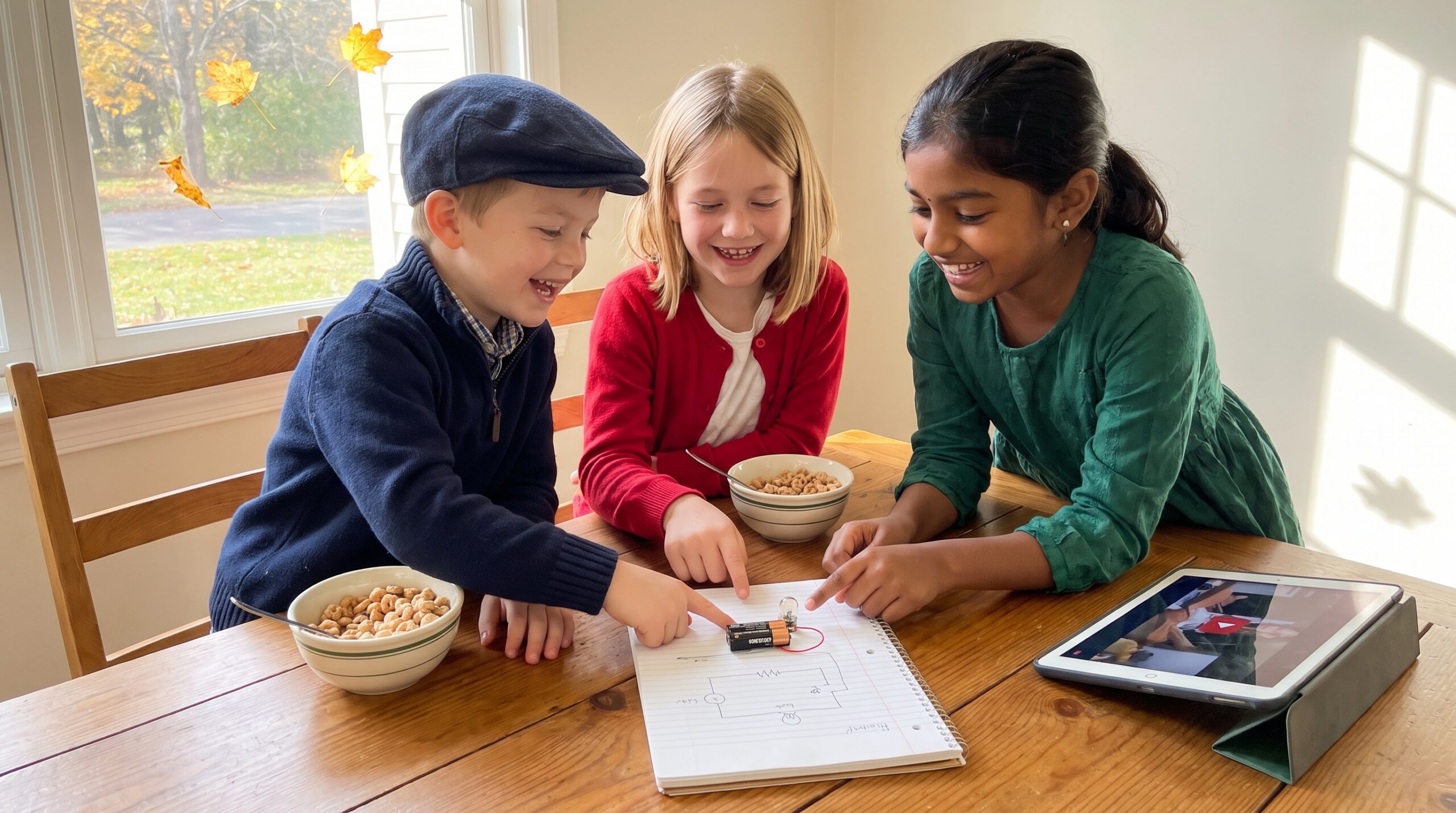
- Explore a simple circuit with a battery, bulb, and switch to show current flow.
- Tinker safely. Let children test, record changes, and try again.
- Work together. Pair up to design small experiments and share results.
A short, joyful anecdote captures the moment. In December 1947, a few people in a small Bell Labs room watched metal contacts on germanium suddenly amplify a sound. They cheered quietly. That intimate surprise led to decades of faster electronics. Small ideas plus teamwork can change everything. In 1956, Brattain jointly received one-third of the Nobel Prize in Physics for their researches on semiconductors and their discovery of the transistor effect, underscoring his recognition and impact on the field, as noted by NobelPrize.org.
Read or listen to a story about Walter Houser Brattain now
Read or listen to a story about Walter Houser Brattain now: For 3-5 year olds, For 6-8 year olds, For 8-10 year olds, and For 10-12 year olds.
For a gentle next step, try a short Storypie tale at breakfast. Visit Storypie to get the app and open little conversations about science, patience, and teamwork.