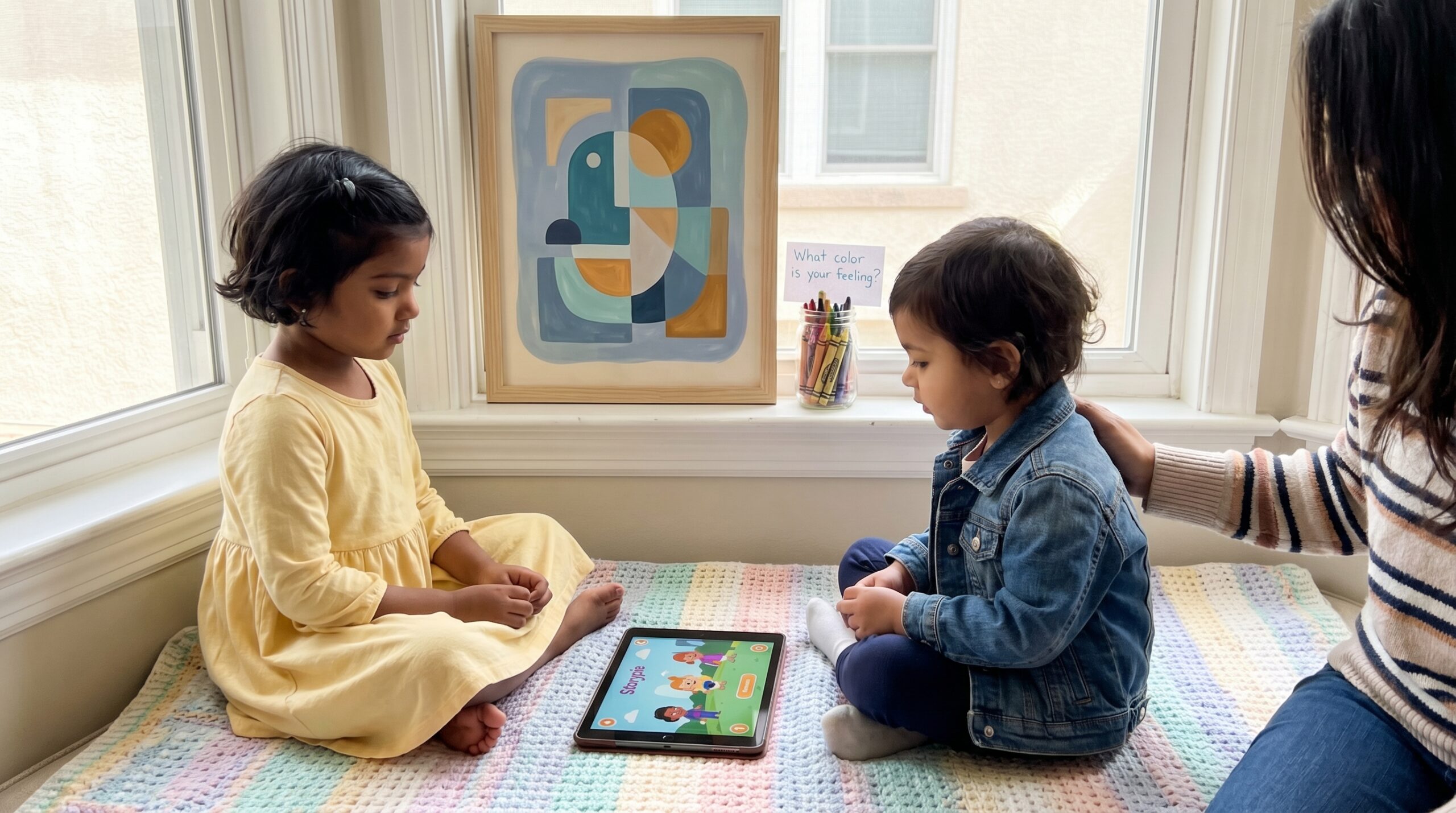
The Weeping Woman Picasso felt small and mighty to me one spring morning. For a parent, it offers a clear way to name sorrow. Also, Storypie carries a child-friendly story that highlights its shapes and colors.
What is The Weeping Woman Picasso?
Picasso painted The Weeping Woman in 1937. He created a series of works that returned to a crying figure from his larger Guernica mural. Therefore, the series links closely to outrage over the bombing of Guernica during the Spanish Civil War. In fact, Picasso created multiple versions of “The Weeping Woman” between June and October 1937, with at least six major paintings and numerous preparatory studies, underscoring the significance of this motif in his body of work (CyPaint).
The Weeping Woman Picasso uses Cubist ideas. For example, Picasso broke faces into planes. Eyes and mouths appear from different angles at once. Also, the colors are bright and not like real skin. Sharp planes and stylized tears make sorrow visible.
Why The Weeping Woman Picasso looks the way it does
Picasso used shape and color as tools. First, he flattened faces into geometric pieces. Next, he exaggerated features to show emotion rather than likeness. As a result, the images feel intense but not graphic.
Critics note the fan shaped handkerchief and jagged planes. Also, the repeated study of one figure deepens the emotional tone. In short, Picasso turned pain into visual language. The Tate Gallery in London holds the most elaborate version of “The Weeping Woman,” created on 26 October 1937, measuring 61 x 50 cm, highlighting the diversity of his approach to this theme (Wikipedia).
Who posed for these pictures
Dora Maar, a photographer and artist, posed for many of the portraits. Her presence adds an intimate and complicated layer to the work. Some critics ask whether painting someone in repeated distress is fair. For older viewers, that question matters.
Versions, museums, and where to find them
Picasso made many versions in oils, prints, and drawings. Famous examples live at Tate in London and Musée Picasso in Paris. The National Gallery of Victoria (NGV) in Melbourne purchased Picasso’s “The Weeping Woman” in 1986 for A$1.6 million, making it the most expensive painting acquired by an Australian gallery at that time (NGV). In a dramatic turn, this version was stolen in August 1986 by a group calling itself the “Australian Cultural Terrorists,” who demanded increased funding for the arts. The painting was recovered 17 days later in a railway station locker in Melbourne, showcasing its cultural impact and the public’s response to art funding issues (Wikipedia). Also, reliable reproductions exist on reputable museum sites and educational pages.
In 2016, Sotheby’s valued the NGV’s version of “The Weeping Woman” at approximately $100 million, illustrating the dramatic increase in the painting’s value over time (NGV).
Read or listen to a story about The Weeping Woman now: For 3-5 year olds, For 3-5 year olds, For 6-8 year olds, For 8-10 year olds, and For 10-12 year olds.
Finally, if you want a gentle introduction, visit Storypie for the child-friendly narration. Also, the series itself remains one of Picasso’s most direct studies of grief.