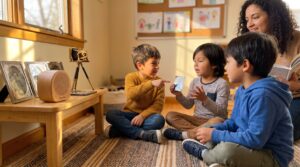
Balancing activities for kids fit perfectly into short, cozy evenings. Try a tiny, active habit that takes just five minutes. First, read a quick tale. Then try one small challenge. Finally, share a laugh.
Quick five-minute balancing activities for kids
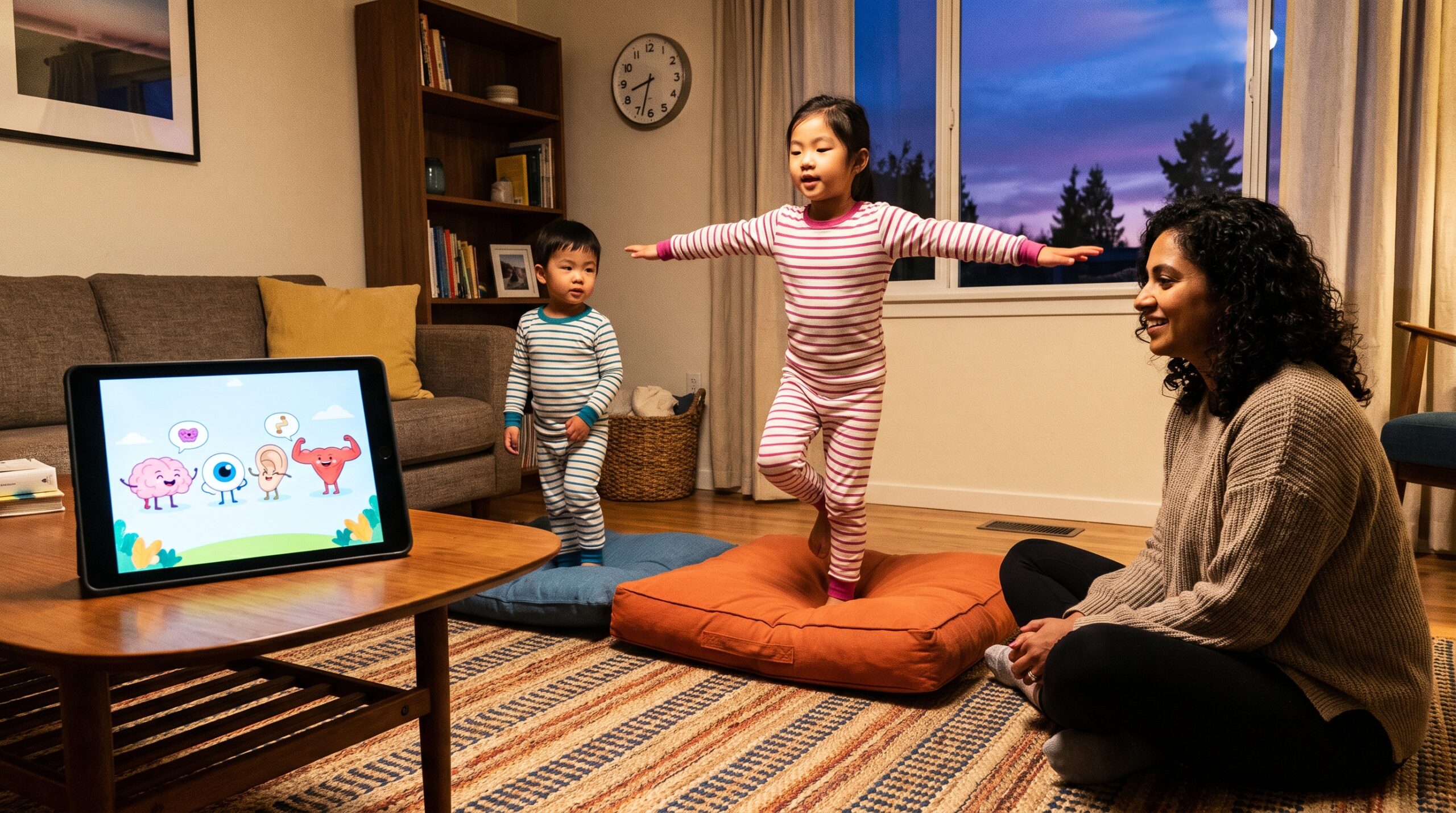
Start tiny. Try one flamingo-stand for 10 to 20 seconds while you count or sing. Hold a hand for support at first. Then drop the hand when the child feels steady.
- Beam walking with floor tape or a low wooden beam. Make it silly by balancing a stuffed animal on the head.
- Hopping races on one foot and heel-to-toe steps along a line.
- Short gentle spins or swings to wake the inner ear. Always keep it mild and fun.
- Barefoot practice indoors to boost foot proprioception.
Practice often and brief. Ten to sixty second bursts, several times a day, beat long sessions. Also, count, sing, or tell a line of a story while you balance. That keeps kids focused and smiling.
Read or listen to a story about Balancing now: For 3-5 year olds, For 6-8 year olds, For 8-10 year olds, and For 10-12 year olds.
Why balancing activities for kids matter
Balancing is a motor skill that keeps the body steady while still or moving. It is not a single sense. Instead, balancing is a team effort. Among U.S. adults aged 40–69, self-reported balance and dizziness problems rose from 21.5% in 2001–2004 to 36.2% in 2021–2023, highlighting the increasing prevalence of balance issues as we age. This emphasizes the importance of balance activities for children to promote early development of stability.
The vestibular system in the inner ear senses rotation and tilt. Vision gives a steady horizon. Proprioception in muscles and joints reports limb position. Then the brain reads all inputs and sends commands to muscles. Together they make steady steps and confident posture.
Typical milestones to watch
Toddlers aged 2 to 3 may hold a single-leg stand for 1 to 2 seconds. Preschoolers around 3 to 4 often hold 3 to 5 seconds. By about 5 years many kids can hold near 10 seconds. Use these as rough guides. Each child moves at their own pace.
Safety and when to seek help
Supervise closely. Practice near furniture or a caregiver for quick support. Use soft surfaces for new skills. Avoid high or unstable equipment without training.
Talk to a pediatrician or pediatric physiotherapist if you notice frequent dizziness, sudden hearing change, very unsteady walking, persistent favoring of one side, or missed motor milestones like not walking by 18 months.
Tools that help are cheap and home-friendly: floor tape, cushions, a low beam, and wobble boards for older kids with supervision. Measure progress with a simple timer or count steps on a taped line.
Try it tonight. Try it during a short Storypie break or while brushing teeth. For a gentle nudge, try the Storypie app: Get the Storypie app. Small wins add up to safer steps and more confident kids.