Binary code how computers count sits inside phones, tablets, and games.
What is binary code how computers count?
Binary uses only ones and zeros. Each digit is a bit, the smallest unit of data. Together bits make bigger pieces like bytes. For example, eight bits make one byte, which can represent 256 distinct values, ranging from 0 to 255, making it essential for understanding how computers process information according to Axiometa.
Bits, bytes, and place values
Bits use place values that are powers of two. Each position in a binary number represents a power of two, with the rightmost position being 2⁰ (1), the next being 2¹ (2), then 2² (4), and so on as highlighted by FPGA Fundamentals. So the places read one, two, four, eight, sixteen, and so on. With three bits you can count zero through seven. For example, five in decimal is 101 in binary because five equals four plus one.
- Three bits: 000 to 111 (counts 0 to 7)
- Four bits: called a nibble
- Eight bits: one byte
How binary builds text, images, and sound
Computers use bytes to store letters, pictures, and audio. Text maps letters to numbers with systems like ASCII and Unicode. For example, capital A is decimal sixty-five, binary 01000001.
Also, images are grids of pixels. Twenty-four bit color gives eight bits to red, green, and blue. Therefore, we get about 16.7 million colors.
Sound becomes numbers too. Devices sample audio many times per second. Often each sample uses sixteen bits for clear, CD-quality sound.
How ones and zeros become physical
Inside hardware, ones and zeros are not magic. They are voltage highs and lows, magnetized spots, tiny pits on discs, or flashes of light. Boolean logic and logic gates combine bits to make decisions. For example, AND, OR, NOT, and XOR gates help circuits compute results quickly.
A short history of binary
People have used binary-like ideas for centuries. Ancient texts such as the I Ching used pattern pairs. The modern binary number system—the foundation of today’s binary code—was first formalized by Gottfried Wilhelm Leibniz in 1689 and published in his 1703 article ‘Explication de l’Arithmétique Binaire.’ Later, George Boole formalized logic. Claude Shannon then linked logic to switching circuits. On 21 June 1948, at 11 a.m., the first stored-program computer, the Manchester Baby, successfully executed software loaded into electronic memory, demonstrating binary code in a stored-program electronic computer for the first time according to Wikipedia. Together, these steps led to modern computing.
Simple activities to make it playful
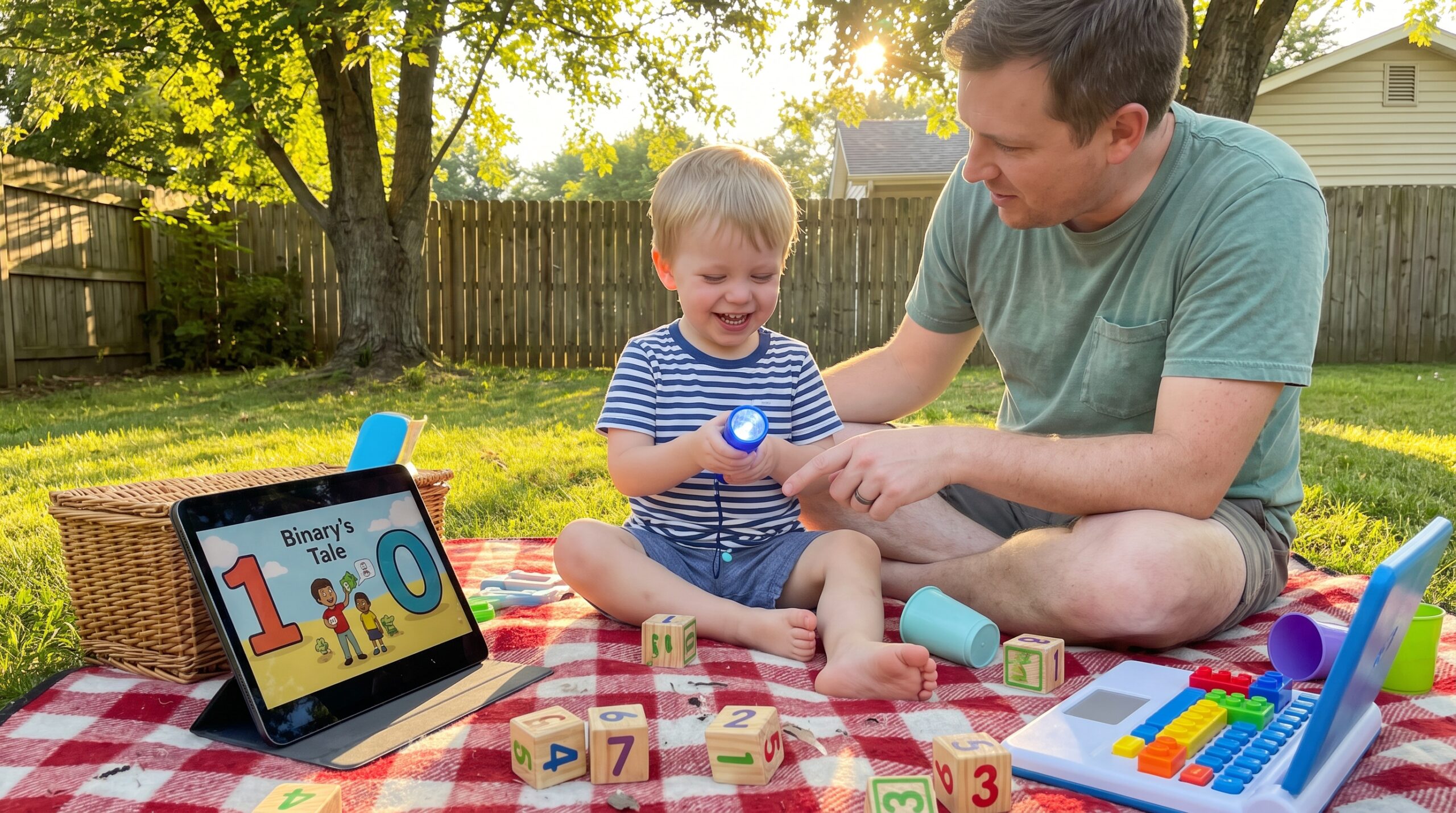
Try a quick flashlight game. Parent taps on for one and off for zero in short beats. Next, spell small numbers in binary. You can also make a binary bracelet with colored and plain beads. Finally, teach finger counting where each finger stands for a power of two.
Safety tip: watch small beads around young children.
Why this matters: your tablet, camera, and games all rely on binary code how computers count. Play and curiosity make the idea friendly and fun. If you enjoy gentle, idea-led stories, explore Storypie for audio and prompts.
Read or listen to a story about Binary Code (How Computers Count) now: For 3-5 year olds, For 6-8 year olds, For 8-10 year olds, and For 10-12 year olds.
Read or listen to a story about Binary Code (How Computers Count) now.
Explore Storypie for more gentle, curious stories at Storypie.