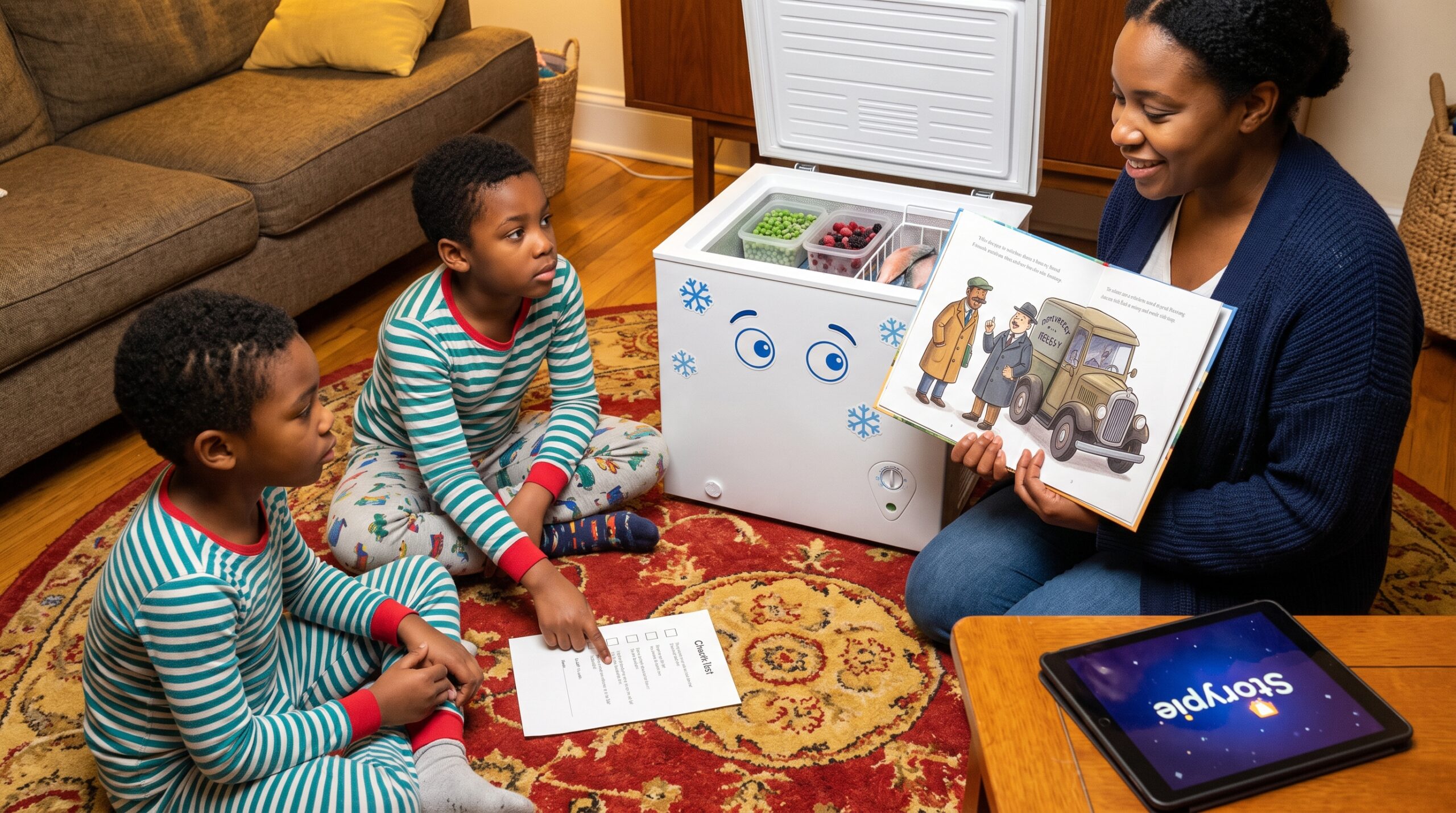
Home freezer guide: I set my freezer to 0°F (-18°C). It keeps food safe and tasty. Parents and teachers will love how simple this rule is.
Home freezer guide: What a freezer is and how it works
A freezer is an insulated box that pulls heat away. It uses a closed-loop refrigeration cycle. A compressor, condenser, expansion device, evaporator, and refrigerant do the work. Think of it as a small engine that moves heat away. It sounds fancy, but the idea is easy and wonderful.
History: quick-freeze and mobile refrigeration
Clarence Birdseye helped popularize quick-freezing. Quick-freezing makes tiny ice crystals that protect texture. Meanwhile, Frederick Jones built mobile refrigeration. His work let frozen food travel far. Together, these inventors shaped our frozen food world.
Packing and labeling tips
Pack smart and keep things airtight. Use heavy-duty freezer bags or airtight containers. Remove as much air as you can. For long storage, vacuum sealing works great.
- Label with contents and the date.
- Use first in, first out for easy rotation.
- Give kids a bin for frozen fruit or snacks to make packing playful.
Temperature and safety
Set the temperature to 0°F (-18°C). The USDA recommends this setting. Cooler temps keep microbes mostly dormant. Freezing keeps food safe but it does not kill all bacteria.
Freezing, storage windows, and thawing
Quick freezing makes small ice crystals. That keeps fruit and fish less mushy. Slow freezing makes big crystals that tear cell walls. Commercial blast freezers and home flash techniques share the same idea on different scales.
Use these rough storage windows as a guide:
- Steaks and roasts: 6 to 12 months.
- Ground meat: 3 to 4 months.
- Lean fish: 6 to 8 months.
- Fruits and vegetables: 8 to 12 months.
- Cooked leftovers: 2 to 3 months.
- Bread: 2 to 3 months.
Thaw safely. The fridge method works best because it keeps food cold as it defrosts. For speed, use cold-water thawing. Change the water every 30 minutes. Use the microwave only if you will cook immediately. If you thaw in the fridge, you can refreeze items, though texture may change. If you used cold water or the microwave, cook before refreezing.
Kid-friendly habits and safety
I like to involve kids. Let them help label and date. Give them a small planning game. Pick one item each week to freeze together. This teaches planning, and it is delightfully simple.
For safety, check door seals and clean coils regularly. Defrost when frost builds. Keep vents clear and avoid overloading. Let hot food cool before freezing. If you have a chest freezer, lock it or supervise closely. Never let kids play inside. Safety first, always.
Maintenance and energy tips
- Check door seals for tight closure.
- Clean coils to keep the compressor efficient.
- Repair before you replace to save resources.
- Recycle old units responsibly so refrigerants are recovered.
- Choose energy-efficient models when you can. ENERGY STAR certified chest freezers consume approximately 215 kWh of electricity annually, costing about $30 per year to operate.
Try this tonight. Ask your child to name one food to freeze. It is simple, playful, and useful.
Read or listen to a story about Freezer now: For 3-5 year olds, For 6-8 year olds, For 8-10 year olds, and For 10-12 year olds. For the main page, visit Read or listen to a story about Freezer now.
Want more family-friendly stories and activities? Visit Storypie for gentle listening and playful learning. According to a study on freezer energy consumption, a typical household freezer in the U.S. uses approximately 586.9 kWh per year, with a typical power draw of 40 to 100 W and daily usage of about 1.61 kWh. This understanding can help consumers gauge the operational costs of their freezers.
Additionally, refrigeration—including freezers—accounts for about 17 percent of global electricity consumption; 45 percent of that is from the residential sector, indicating that domestic refrigeration/freezing uses nearly 8 percent of total global electricity, as highlighted in a 2024 report on domestic energy use.