
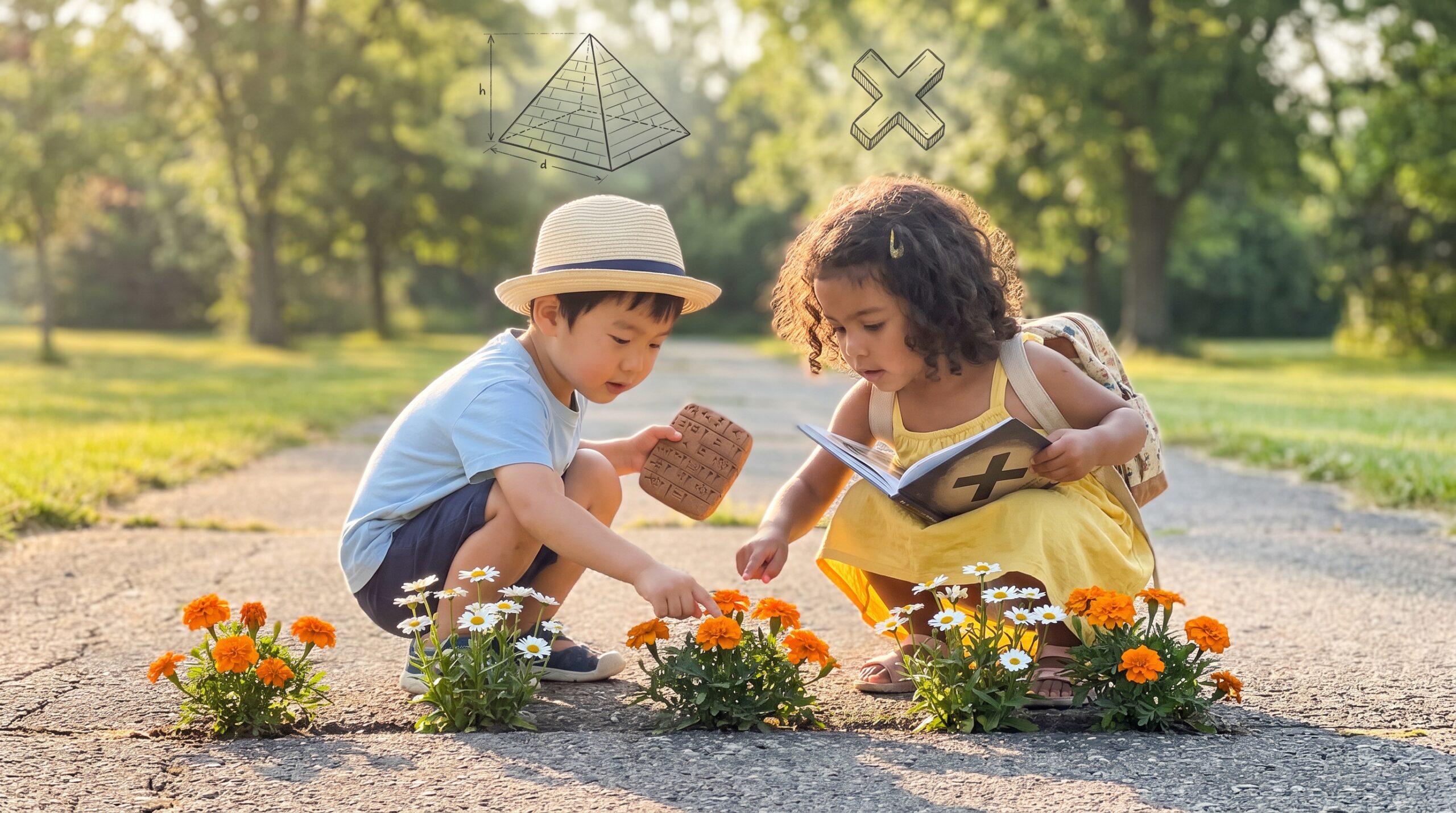
Multiplication for kids is a small idea that opens many doors. At its heart multiplication means repeated addition, scaling, and counting equal groups. For example, 3 × 4 reads three times four and gives twelve. Also, it can be an array and the area of a rectangle.
Early history and surprising origins
The story of multiplication goes far back. Ancient Babylonian clay tablets from about 2000 BCE record multiplication problems pressed into wet clay. Egyptian builders used doubling and adding to plan blocks and measure fields. Later, in the 1600s, William Oughtred introduced the × symbol we still use today. So multiplication links pyramids and planning with classroom arrays.
Core rules and tidy patterns of multiplication for kids
Multiplication follows tidy rules that make it dependable. For example, it is commutative: 3 × 4 equals 4 × 3. It is also associative and distributive. Multiply by one keeps size the same. Multiply by zero gives zero. These properties help children move toward fractions, decimals, area, and algebra. However, many children face challenges early on; in fall kindergarten, less than 0.5 percent of children demonstrated proficiency in multiplication and division, highlighting the need for early interventions (U.S. Department of Education).
Everyday models and playful ways to notice patterns
Children learn best with clear models. Arrays and rows show equal groups. Number-line jumps teach skip-counting. Area models link multiplication to shapes. Egyptian-style doubling becomes a neat mental trick. For multi-digit problems, long multiplication or lattice methods show structure. Games, songs, and finger tricks turn facts into tiny celebrations. Tiny wins feel enormous when patterns click. Despite these strategies, by fifth grade, only about 19.4 percent of students scored between 80 percent and 100 percent correct on multiplication operations, emphasizing the need for effective teaching methods (The quandary of diagnosing mathematical difficulties).
Where multiplication shows up
Multiplication appears in nature and in play. For example, cell division doubles counts. Branches split and petals often form regular arrangements. Building projects and tiles rely on rows and columns. Ancient surveyors used the same ideas when measuring land for pyramids. Look for symmetry and repetition and you will see multiplication at work.
Simple tips for parents and teachers
Short, hands-on practice beats long sessions. Try five minutes each day with buttons, shells, or blocks. Walk together and count groups you see. Then ask your child to say the multiplication sentence and draw a tiny array. Celebrate clear reasoning, not only correct answers. A small celebration fuels confidence and curiosity. It’s also valuable to note that at the end of Grade 1, just before formal instruction in multiplication, students could already solve about 58 percent of multiplicative problems correctly, which shows they have a foundational understanding even before formal teaching begins (Using mini-games for learning multiplication).
Quick activity to try
Lay out four rows of three pegs and count by threes. Draw the matching rectangle. Say the product aloud. Repeat with different numbers. Keep it playful. Keep it small. Finally, take a summer walk and count petals, birds, or doorsteps. Take a photo and make a little array at home.
Read or listen to a story about Multiplication now: For 3-5 year olds, For 3-5 year olds, For 6-8 year olds, For 8-10 year olds, and For 10-12 year olds.
Want more stories and playful practice? Visit Storypie at mystorypie.com for gentle ideas and curated activities.